Author Archives: usjapanesegardens

Unknown's avatar

About usjapanesegardens

Enthusiastic supporter of Japanese gardens; founding member of the North American Japanese Garden Association; founding member Friends of Lili`uokalani Gardens; loves travel and photography

Fort Worth garden should be seen every season

The Japanese Garden at the Fort Worth Botanic Garden is worth a return visit, in my opinion, every season of the year. Every season has its joys. The variety of plantings and styles of Japanese garden at Fort Worth offer that special kind of joy to all.

I visited two years ago in the spring, took 100 photos in an hour’s time, and have been mentioning it to my husband ever since. Our recent visit this summer, his first, entranced him as much as my first visit did me.

This seven and a half acre site was a watering hole for cattle, a gravel pit, a dump, and a squatters’ camp before Scott Fikes, former Botanic Garden director, and Charles Campbell, former director of Park and Recreation came up with and pursued the idea in the late 1960s. Kingsley Wu, a graduate of the University of Tokyo, was commissioned to finalize plans, according to a garden brochure, and construction began in 1970. After many clubs, companies and individuals put in their time, talent and treasure, the garden opened in 1973.

The resulting collection of gardens offers a pleasant stroll from the main gate through the free courtyard garden to the ticket office to the green and cool delights beyond.

The main gate was designed by Albert S. Komatsu and dedicated to Scott Fikes in 1976. The gift shop is off to the left.
(photo by Bill F. Eger)

A little history on the early designers

The main gate was designed by Albert Komatsu and Associates, an architectural firm founded in 1959 and later known as Komatsu Architecture. Alfred Komatsu was a well known, award-winning and highly respected architect in Fort Worth. He helped found the Society of American Military Engineers post in Fort Worth (SAME) and in 2011 was its oldest living founder.

The main gate was dedicated to Scott Fikes in 1976. Fikes retired in 1975 after serving 17 years as the Fort Worth Botanical Garden’s director. He served in the U.S. Army in World War II and was a member of the National Society of Landscape Architects. He passed away in 2002.

Charles Boyle Campbell was a landscape architect by training. He was 39 years old when he accepted the position in Fort Worth as director of parks in 1962. Two years later, the parks and recreation boards were merged and Campbell was named director of the new department.

“Throughout his quarter-century of service, he was a strong advocate for the creation of green space, and during his tenure, city regulations were amended to require residential developers to set aside parkland in their subdivisions. During the years he served as director, the number of parks increased from 57 parks on 2,872 acres to 163 parks with 9,923 acres,” said Susan Allen Kline in the book Images of America: Fort Worth Parks. Campbell retired in 1987 and passed away in 2006.

Steve Huddleston remarked on Kingsley Wu on the occasion of the 75th anniversary of the Fort Worth Botanic Garden: “The major project in the garden during the late ‘60s and early ‘70s was the construction of the Japanese Garden, a 7.5-acre garden that is now the crown jewel of the Fort Worth Botanic Garden. In 1968, the city employed Kingsley Wu, professor of environmental living at Texas Women’s University, to design a master plan for the Japanese Garden.  The three major pools were staked and then 454 cubic yards of concrete were poured to line the pools. A waterfall, spillways, and islands were fashioned in and around the pools.  Patterned after the Ryoan-ji in Kyoto, the meditation garden was built in 1970.”

a school group enjoys the classic karesansui
(photo by Bill F. Eger)

Among new plantings this spring are cherry trees, the gift of the Japanese Embassy to mark the centennial of Tokyo’s gift to the United States of more than 3,000 cherry trees planted at the Tidal Basin in Washington, D.C.

“The most reliable and readily available variety of flowering cherry is the ‘Kwanzan’ (Prunus serrulata ‘Kwanzan’),” says Scott Brooks, senior gardener at FWBG. He oversees the 7 ½ acre Japanese Garden there. “It’s capable of reaching 25 feet in height with branches that start out upright and then spread horizontally. It has 2-inch-wide, rose-pink flower clusters. Newly planted trees produce a good showing of flowers, although bloom improves as the trees mature.”

Another variety that does well here, Brooks says, is Yoshino (Prunus x yedoensis), the variety Japan gave to the United States in 1912. It’s a fast-growing tree that can reach more than 30 feet. Although the young trees do not produce a lot of flowers, mature trees bloom profusely.

Springtime crabapple bloom with new maple leaves near the pavilion in 2010

Brooks came to the garden in 1982 as a groundskeeper. By then many of the original trees had matured. The garden was clotted with vines and undergrowth. Tunnels had formed where the original designers had created paths.

Brooks set about the hard work of carefully uncovering what Fikes, Campbell, Komatsu and Wu had created, traveling several times to Japan. There gardeners steeped in 1,500 years of tradition taught him: “If you’re the keeper of a Japanese garden, you need to think about removing something every year,” he said.

dry stream
(photo by Bill F. Eger)

Brooks now is the senior gardener. He showed us through, with that ever watchful gardener’s eye for something amiss or out of place, and spoke of the delights and challenges of this ever changing scene.

Sister City

Nagaoka and Fort Worth have an active and dynamic Sister City relationship, celebrating 25 years this year in October. Mayor Betsy Price and Councilman Danny Scarth will lead a delegation to Nagaoka, Japan, to join in their fall festival October 2 to 12.

In the 1990s, Nagaoka, donated an authentic Mikoshi (a gilded and lacquered palanquin) to Fort Worth, which is currently on display within the Mikoshi House. Several trees, including pines and flowering cherries, were similarly donated.

Mikoshi — a gift of Sister City Nagaoka

view out the door of Mikoshi House

Mikoshi House in the spring of 2010

In 1997, Mr. Shigeichi Suzuki, a landscape architect from Nagaoka, donated plans for a karesansui-style addition to the garden.

“When I received the plans, they were in kanji and metric,” said Brooks chuckling. “That was a wonderful challenge figuring that out.”

The addition was completed in 2000, and is now called the Suzuki Garden. It is a modern counterpart to the nearby classic karesansui of the same design as the abbot’s quarters of Ryoanji in Kyoto.

Suzuki Garden
(photo by Bill F. Eger)

The tea house at the end of the pond was built as a memorial to the late Mary K. Umstead, secretary to the Horticulture Division. It was rebuilt this past year using plantation-grown ipe as a more lasting, sustainable tropical hardwood.

Mary K. Umstead Tea House, rebuilt in the past year

A new barrier free approach to the pavilion area offers visitors a closer view of the main waterfall. The Shinto-esque pavilion area offers several structures available for rental for special celebrations and weddings.

new waterfall view
(photo by Bill F. Eger)

Behind the pavilion area, a small staircase leads to a plaza. Out of view to the right is barrier free access to the same area.
(photo by Bill F. Eger)

moon-viewing platform and amphitheatre
(photo by Bill F. Eger)

“The ‘Moon-Viewing Deck’ is a creative adaptation of the Ginkakuji temple’s famous ‘Kogetsudai’ sand cone. Fort Worth’s version is intended to be an interactive karesansui exhibit, in which visitors may ascend the flat-topped cone via steps, and view the composition from above. A ‘Taijitu’ (a yin-yang symbol), lies embossed in exposed-aggregate concrete at the summit. This highly unusual (but fun) addition to a Japanese garden is ultimately a cosmological symbol of Chinese origin. It also has other interpretations, including its most important contemporary association with Korean culture, and as a metaphor for oriental mysticism in American ‘Pop’ culture. The exhibit also features an amphitheatre that is countersunk into the same platform as the cone. Together, they serve as a performance venue for the garden’s two annual festivals (matsuri), and as a moonlit chapel for weddings,” Brooks said

Paths

In all, there are nearly 6,000 linear feet of stone, brick, wood, aggregate concrete and asphalt walkways in the garden, three pools and a couple of waterfalls including a small one in the corner of the entry to the gift shop, seven crossings over water, multiple fish food dispensers, an abundance of healthy koi in the ponds and plants to occupy the eye and mind.

gift shop in the spring of 2010

gift shop in the summer 2012 — note the impact of recent drought on the pond water level
(photo by Bill F. Eger)

Treasure Tree gift shop occupies a waterside structure reminiscent of medieval Japanese architecture. The well stocked store is operated by the Fort Worth Botanical Society. Proceeds benefit the continuing development and preservation of the garden.

The garden is included in the Fort Worth Botanic Garden web site http://fwbg.org/gardens/japanese/ and maintains its own Facebook page http://www.facebook.com/pages/Fort-Worth-Japanese-Garden/168365139854742 on which Brooks has included several detailed guides to the plantings in multiple scrapbooks.

Operating hours during standard time are 9 a.m. to 5 p.m. daily and during daylight saving time 9 a.m. to 7 p.m. daily except Christmas. Admission fee for adults is $4.50 on weekends or $4 on weekdays; $3 for children ages 4 to 12. Children ages 3 and under are admitted free. Unsponsored children under 13 are not admitted. One adult may sponsor 5 children.

For additional information, call (817) 871-7686.

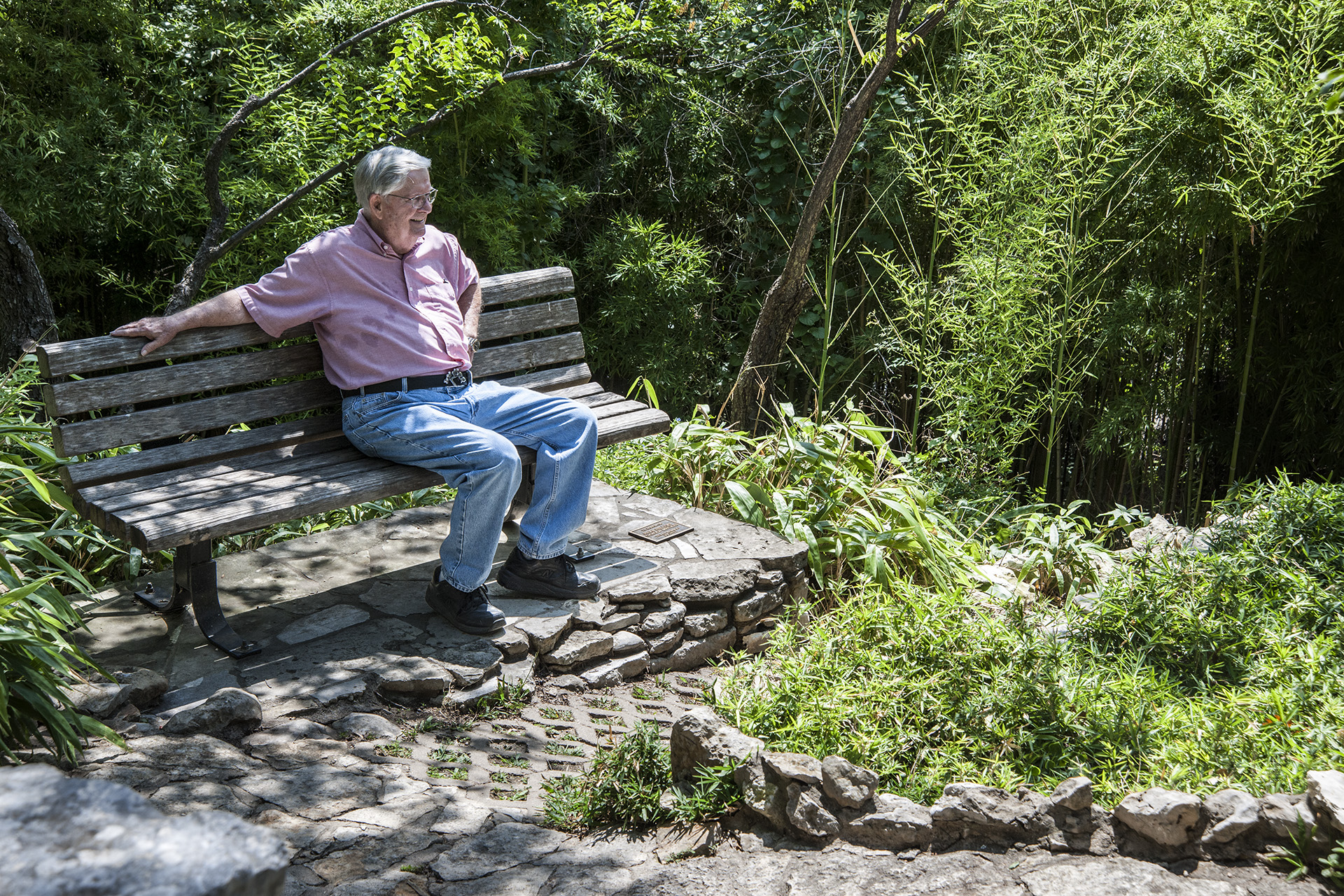
enticing benches
(photo by Bill F. Eger)

Photos with no credit line in this blog are by K.T. Cannon-Eger. Click on any image to see it full size.

Several videos of the Fort Worth Japanese Garden are featured on YouTube. Here is a short one from the spring festival http://www.youtube.com/watch?v=Xqj2KIb-DQs

and a longer piece featuring spring blooms

http://www.youtube.com/watch?v=4FWsA2UCqUY

another featuring a summertime stroll with emphasis on the koi http://www.youtube.com/watch?v=j_ysysau35U

a taiko performance of Ujigawa by Dondoko Daiko at the 2009 fall festival http://www.youtube.com/watch?v=upJ-5udVI4s

and one longer narration from winter http://www.youtube.com/watch?v=0dZCKCbo378

A personal note:

There’s something really wonderful about garden friends: you speak the same language, share similar goals, and in the best of times have the same taste in movies and jokes. Scott Brooks is one of those wonderful garden friends.

We met briefly in Long Beach, California, in spring of 2009 at the International Conference on Japanese Gardens Outside Japan. A year later, I stopped off in the Dallas-Fort Worth area on my way home from my mother’s death in Florida. My cousin dropped me off at the garden gate and I began my wandering in a somber mood.

Pretty soon, I was engaged by the collection of gardens – entranced by proportions, variety and trimming of various plantings.

Scott Brooks at work in 2010

As I wandered down the right side of the garden, I noticed maintenance going on at the left side of the pond. I kept catching glimpses of this man in a black t-shirt pushing a wheelbarrow. When I finally came even with him, I asked the perennial gardener’s question, “What are you working on?” “Re-doing the water pipe to this basin,” he replied “Have you been here long?” I asked. “28 years since 1982.” “Say, you look familiar….” and when we got to Long Beach as common ground he exclaimed, “You’re that lady from Hawaii.”

forsythia near the pag

Later, as I approached the end of the path to meet up with my cousin at the gift shop, there was a splash of yellow by the pagoda – forsythia, one of my mother’s springtime favorites.

The Long Beach conference not only formed fast friendships, it led to the formation of the North American Japanese Garden Association (NAJGA). Fort Worth hosted one of the regional meetings that led the group from initiative to association.

The organization hosts a web site http://www.najga.org/cfm/index.cfm and a Facebook page. NAJGA will host Connections 2012, a conference for garden professionals and enthusiasts in Denver, Colorado, October 12 through 14 with a one-day advance design workshop on October 11. The conference is geared toward three topics every garden deals with: horticulture, human culture and business culture. Contact NAJGA for further information and to register.

pagoda designed by Albert Komatsu
(photo by Bill F. Eger)

Categories: Fort Worth, Texas | Tags: , , , , , , , , , , , , | 2 Comments

Taniguchi’s gift to the city of Austin

The Isamu Taniguchi Garden at Zilker Botanical Garden undoubtedly has the best view of Austin, Texas.

“The best view in town” according to one garden volunteer is from the Isamu Taniguchi Garden at the Zilker Botanical Garden.
(photo by Bill F. Eger)

Many thanks are due Marion Alsup for her hospitality during our recent visit to the Taniguchi Garden at Zilker Botanical Garden in Austin, Texas. She greeted us at the train station, hung cool scarves around our necks, pressed bottles of water into our hands, plus she organized other garden personnel to meet us on site to answer additional questions . Alsup is vice president of the Austin Area Garden Center with responsibility for education and president of the Docents of Zilker Botanical Garden. She provided running commentary as we toured the winding trails.

Marian Alsup and Donna Friedenreich explain the Sister City relationship with Oita, which gave this stone gate to the garden.
(photo by Bill F. Eger)

Three acres of rugged caliche hillside were transformed into a garden in the late 1960s by Isamu Taniguchi when he was 70 years old. Working for 18 months with occasional help from two parks and recreation department staffers, Taniguchi brought forth his gift to the city of Austin first in gratitude for the education that his two sons received there and second in an aspiration for peace.

lantern at top entry to the garden
(photo by Bill F. Eger)
Taniguchi was born in Osaka, Japan. By the age of 16 he was raising bonsai. Migrating to Stockton, California in 1915, he farmed vegetables and fruit, returning to Japan only once to marry. During World War II, he and his family were interned in California and Texas. The family moved to the Rio Grande Valley at the end of the war to continue farming.

The Austin Area Garden Center and the Parks and Recreation Department could not turn down his generous offer of a garden. Working without a salary, a contract or a written plan, Taniguchi showed up for work, rain or shine, and created paths and streams, waterfalls and ponds, stone arrangements and plantings. The garden opened to the public in 1969. Taniguchi’s son Alan was Dean of the UT School of Architecture that year.

An essay by the elder Taniguchi – The Spirit of the Garden – describes not only the garden, but its builder:

“It has been my wish that through the construction of this visible garden, I might provide a symbol of universal peace. By observing the genuine peaceful nature of the garden, I believe that we should be able to knock on the door of our conscience, which once was obliged to be the slave of the animal nature in man rather than of the humanity which resides on the other side of his heart. It is my desire for the peace of mankind which has endowed this man of old age the physical health and stamina to pile stone upon stone without a day’s absence from the work for the last 18 months. It is my desire for peace of mankind which encouraged me in my voluntary labor to complete this long-dreamed gift for the city of Austin – this Oriental Garden. It is my wish that you have pleasant communion with the spirit of the garden.”

A small lantern and a hidden waterfall are part of the ponds that spell out “Austin.”
(photo by Bill F. Eger)

Several garden ponds spell out the word “Austin.”

(photo by Bill F. Eger)

A rustic wooden log Togetsu-kyo or “Bridge to Walk Over the Moon” is nearby.

The final pond holds lotus Taniguchi raised from a seed from Japan and several varieties of water lily. There is a small central island in the shape of a boat with stepping stones through the pond in the shape of the boat’s chain and anchor.

The lowest pond features a boat-shaped island with wisteria, water lilies and lotus grown by Mr. Taniguchi. The story of the lotus seed — Journey of the Third Seed — is recounted as a children’s story by Jane Scoggins Bauld.
(photo by Bill F. Eger)
Taniguchi continued to be involved with the garden leading occasional tours. He died in 1992.

Terry Ward, bonsai master and garden volunteer was present for the planting of many of the older trees in the garden. “I’ve helped train several garden staff in the art of pruning the trees.” New staffer Robert “Spider” DeVictoria came to the Taniguchi garden two and a half years ago from Brooklyn where he recalled falling in love with Japanese gardens at the botanical garden there.

Terry Ward enjoys the view from one of several comfortable benches throughout the garden.
(photo by Bill F. Eger)

There are some outstanding maples and 21 kinds of bamboo in this 3-acre garden.

Thirty different garden clubs such as the Austin Pond Society, Texas Bamboo Society, the Austin Bonsai Society, the Austin Ikebana Study Group and other associations were organized into the non-profit Austin Area Garden Center in 1955. The Austin Park and Recreation Department owns the land. The Garden Center built the building, organizes volunteers, trains docents and staffs the gift shop, according to Donna Friedenreich, president of AAGC.

The Heart O’Texas Orchid Society donated a Japanese teahouse with a view of the Austin skyline beyond the bamboo. It is named Ten-Wa-Jin (Heaven, Harmony, Man) to convey once more Taniguchi’s message that man exists in harmony with nature and that a “garden is the embodiment of the peaceful coexistence of all the elements of nature.”

Ten Wa Jin teahouse at the Taniguchi Garden
(photo by Bill F. Eger)
interior detail
(photo by Bill F. Eger)

Local materials were used in tea house construction. The bamboo society helps every year.
(photo by Bill F. Eger)

detail of roof
(photo by Bill F. Eger)

view from the teahouse
(photo by Bill F. Eger)

Stone gates flanking a newer slate path were a gift from Austin’s Sister City Oita, dedicated in November 1999 to mark the lasting friendship between the two cities.

English text is on the interior of the western gate.

“Once a year, a garden festival is held, usually during the last weekend in March. In 2013, the garden festival will be held the first weekend in April due to the Easter holiday,” said Marion Alsup, Docent Club president.

new gate at the north end
(photo by Bill F. Eger)

The garden recently received a generous donation from the Orton family, which was used to reconstruct an existing path to meet ADA requirements, adding a new gate at the north end.

detail of new gate
(photo by Bill F. Eger)

In addition, the garden receives welcome support from the Japan America Society of Greater Austin.

The city books weddings to be held in the garden and retains the revenue. Other events are partnered with AAGC and the proceeds are split. According to Friedenreich, one highly successful event funded repair of leaking ponds with Dragon Coat.

Each year, the garden hosts several hundred thousand people. Thousands of school children are reached by the Zilker Botanical Garden’s educational outreach programs and many school groups come for a visit. It was a delight to see the school children enjoying the waterfall, lanterns, niche in the stone tea house for tea cups, resident snake, and trimmed bushes all with respect and deepening calm.

One group of school children enjoyed the garden while we were there.
(photo by Bill F. Eger)

For more information on how those of you in the Austin area can support the Zilker Botanical Garden, e-mail info@zilkergarden.org or phone 512-477-8672.

Taniguchi garden at the Zilker Botanical Garden may be found at:

http://www.zilkergarden.org/gardens/japanese.html

Should you wish to view a very sweet video of the Taniguchi Garden, check out this one created a year ago by Austin Otaku.

http://vimeo.com/austinotaku/isamu-taniguchi-japanese-garden

Unless otherwise credited, photos in this blog are by K.T. Cannon-Eger. Click on any image in order to see it full size.

Categories: Austin, Texas | Tags: , , , , , , , , , , | 11 Comments

Jingu House and the Japanese Tea Garden

The article below was published immediately after a visit to the garden in 2012. The following link leads to an October 5, 2015, article by Jack Morgan of KSTX San Antonio. The article in turn includes links leading to more information on the garden and on Japanese Gardening dot org.

http://tpr.org/post/incredible-story-behind-san-antonios-japanese-tea-garden#stream/0

In Texas, when I said, “We’ve been to a Japanese garden in San Antonio,” many people thought I was referring to the Japanese Tea Garden at Sunken Gardens, Brackenridge Park. I was referring to Kumamoto en, detailed in an earlier post about the San Antonio Botanical Garden.

But there is a story here at Sunken Gardens – another sad story of a family losing their home and livelihood due to fear during World War II and another hopeful story of better things to come.

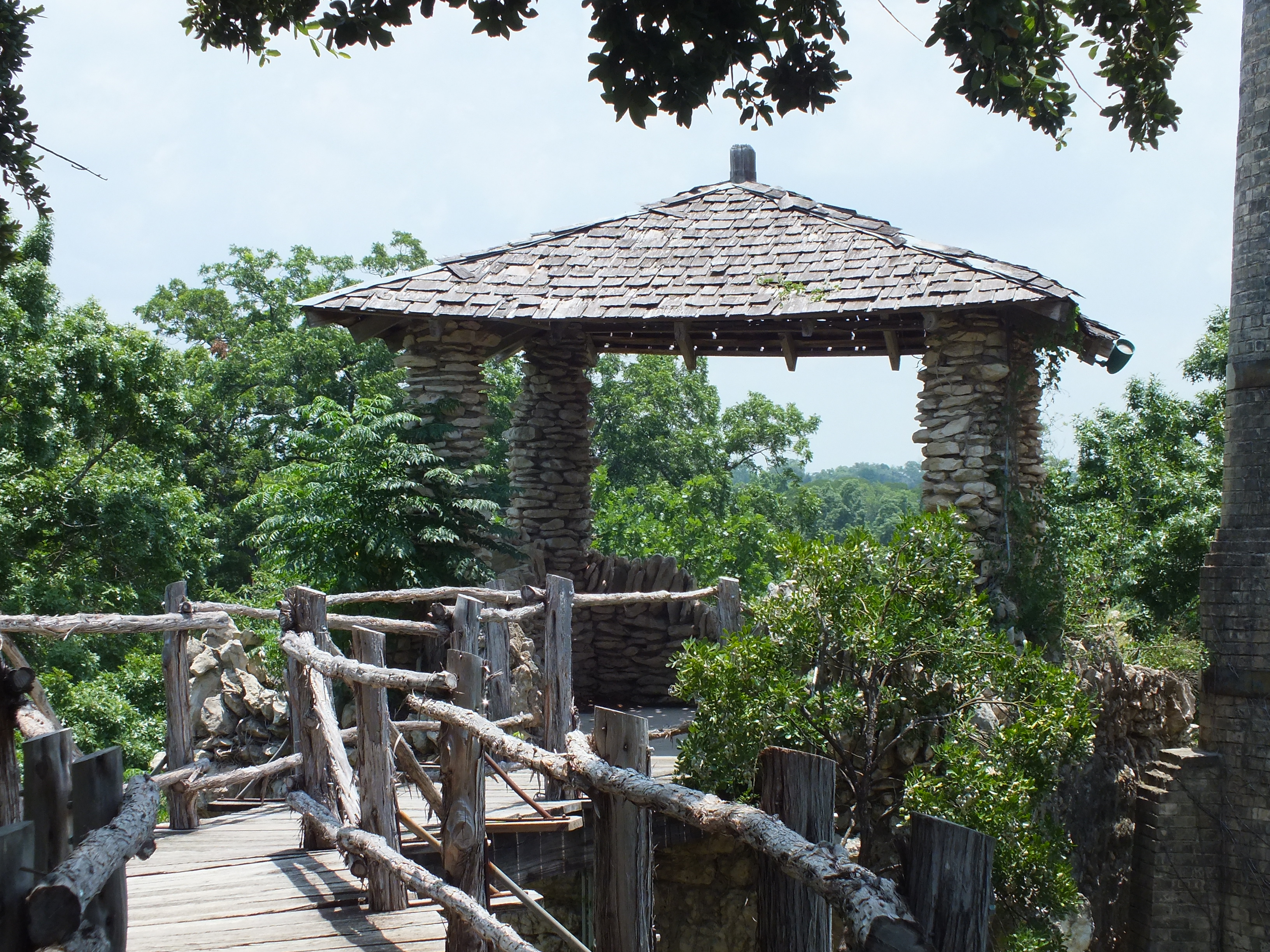
There are many striking features about this garden – the stonework on paths, benches, structures and ponds alone is worth a visit. Initially, in 1840 the property was a quarry. In 1880, the Alamo Roman and Portland Cement Company constructed the first cement plant west of the Mississippi. A smokestack near a gazebo overlook marks the kiln that was built in 1889.

The story of the garden is told on a 1984 brass plaque adjacent to the entry gate, an unusual torii style structure in the fois bois design bearing the inscription “Chinese Tea Garden.”

The torii gate created by Dionicio Rodriguez is a national landmark. Text of the plaque at the right is reproduced below.
(photo by Bill F. Eger)

The plaque reads: “The idea of a Japanese tea garden was conceived by City Parks Commissioner Ray Lambert in the early 1900s in an effort to beautify the rock quarries which had earlier been abandoned by the San Antonio Portland Cement Company. The brick and stone smokestack east of the teahouse is part of the old Portland Cement kiln.

The kiln smokestack at the extreme right of the photo is all that is left of the old cement plant. The gazebo overlook is on the list of things to be refurbished at the Japanese Tea Garden in San Antonio.

“Commissioner Lambert enlisted the aid of a Japanese artist Kimi Eizo Jingu to assist in the design of an authentic Japanese tea garden. Artist Jingu had recently arrived in San Antonio with his family, had been employed by the U.S, Army and was selling his watercolor paintings in a shop in downtown San Antonio.

“The Japanese tea garden was completed and christened in 1919 having been constructed with prison labor and with both corporate and individual donations. Commissioner Lambert had given particular effort to achieving true Japanese design and had imported numerous plants from gardens existing in Japan. A house was constructed on the site using rocks from the old quarry, and the Jingu family was moved into the house to act as overseers for the facility. In 1926, the Jingus opened a tea house in the upper level of their home. Before his death in 1936, Mr. Jingu had become nationally recognized for his knowledge of teas.

Jingu House Cafe is open Tuesday through Saturday 9 a.m. to 4 p.m. This view shows improvements done recently to allow for barrier-free access.
(photo by Bill F. Eger)

“The Jingu family remained in their home in the garden until shortly after the December 7, 1941, Pearl Harbor incident. The resulting general fear and resentment by the American public caused the Jingu family to be removed from the garden and its name was changed to Chinese Tea Garden.

old postcards framed upstairs in Jingu House Cafe
(photo by Bill F. Eger)

“It was at this time the Chinese-style entry was added, bearing the inscription ‘Chinese Tea Garden.’ This Oriental-design cement-sculptured entry was purportedly designed by Maximo Cortez and constructed by Dionicio Rodriguez. Mr. Rodrigues was a Mexican national who is credited with a number of cement sculptures in San Antonio. He kept his techniques secret working always inside a tent and using tools he made on the site from tin, wood, etc. His process consisted of a metal rod base on which he developed three-dimensional designs with layers of especially prepared cement. He did not divulge either his process of cement sculpture or coloring of the cement layers. He spoke no English and a few co-workers learned by observation only. He is credited with having created various other sculptures throughout the United States in addition to those in the San Antonio area.

“In 1983, the San Antonio City Council ordained that the original name of “Japanese Tea House” be restored to the site in consideration of the number of Japanese-Americans who had fought honorably on the side of the United States during World War II.”

It should be noted here that the youngest sons James and Kimi Jingu served in the U.S. Army. James received a Purple Heart for his actions with the 442nd in Europe and Kimi served in the Korean conflict. See one newspaper article here: http://www.flickr.com/photos/42448022@N05/3967648434/

an overview from the vantage point of the pavilion
(photo by Bill F. Eger)

Toward the back of the property, bamboo leans over a section of original steps.

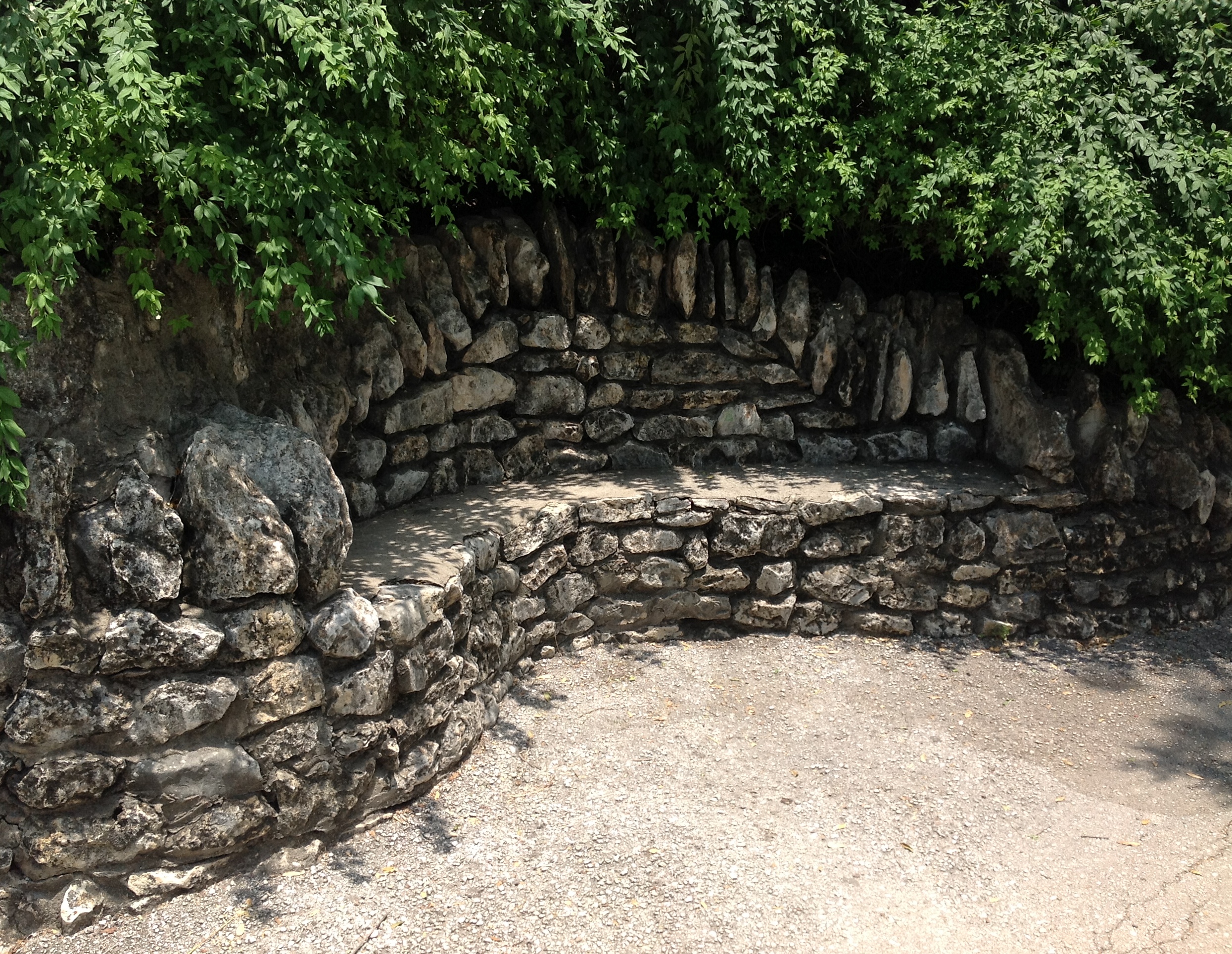
one of the original stone benches

Don Pylant notes current happenings in his article

http://www.japanesegardening.org/sunkengardens/index.html

“A move to restore the Japanese Tea Garden came in the 2005 bond election to repair the Pavilion. With help and guidance from San Antonio Parks Foundation and Friends of the Parks, this Phase 1 began. The original roofing was fencing wire with palm leaf thatch, harvested from the city parks, woven together to shed water. The new roof is a fantastic mimic of artificial palm thatch – all the looks without the fire hazard.

the reconstructed pavilion
(photo by Bill F. Eger)

“In 2007, former councilwoman Bonnie Conner, Parks Foundation vice chair of projects, and former Mayor Lila Cockrell, Parks Foundation president, began a $1.6 million restoration campaign to repair the lily ponds. The successful effort resulted in the restoration of the ponds, a new re-circulating filtration system, and the return of fish and lilies to the ponds. For the public re-opening on March 8, 2008, Jingu and Lambert family members were present. Mabel Yoshiko Jingu Enkoji, the sixth child of Kimi and Miyoshi Jingu, and born at the Gardens, was the senior Jingu family member at the event. Richard Lambert, grandson of Commissioner Ray Lambert was also present.

detail of interior of re-done pavilion
(photo by Bill F. Eger)

“A master plan is being created and fundraising will begin soon to continue the effort to return the Japanese Tea Gardens to its former glory as a jewel in the crown of San Antonio and South Texas.”

HUGE koi
(photo by Bill F. Eger)

A problem common to all gardens with koi ponds — birds that like to go fishing!
(photo by Bill F. Eger)

Side note: for more on Dionicio Rodriguez and his Trabajo Rustico, see the book Capturing Nature: The Cement Sculpture of Dionicio Rodriguez by Patsy Pittman Light.

Unless otherwise credited, all photos in this blog are by K.T. Cannon-Eger. To see a full size image, click on the photo.

Categories: San Antonio, Texas | Tags: , , , , , , | 3 Comments

Kumamoto en in San Antonio, Texas

Oribe lantern at the entrance — for more information on this type of lantern and others, check out the story on the Japanese Gardening Organization web site:
http://japanesegardening.org/lanterns/index.html

Kumamoto en, the Japanese garden at San Antonio Botanical Garden, is a small polished gem set amid 33 acres of living museum. Enclosed by four bamboo walls, the garden presents a series of scenes reminiscent of famous gardens in Japan.

Approaching the entry to Kumamoto en, we were struck by the detailed workmanship in the daimyo or shogun style bamboo fence. More information on how to construct such a fence is available here:
http://www.japanesegardening.org/reference/daimyo_fence.html
(photo by Bill F. Eger) 

The garden was a gift of Sister City Kumamoto and first opened in 1989. Landscapers and craftsmen from Kumamoto, Kyoto, Tokyo and San Antonio participated in its design and construction. A complete restoration was accomplished in 2005.

“Upon entering the garden, you enter a place apart from the everyday world, a safe and peaceful haven where all anger, prejudice, and worldly problems are left at the gate,” writes Don Pylant in an article on the garden and its Sister City relationship with the City of San Antonio in http://japanesegardening.org/kumamotoen/

Exquisite workmanship gives the Katsura style bamboo fence a subtle checkerboard pattern. More information on construction technique is available here:http://www.japanesegardening.org/reference/bamboo_fence.html
(photo by Bill F. Eger) 

“Kumamoto en was designed to demonstrate the beauty of authentic Japanese gardening and introduce visitors to many elements used in Japanese Gardens. It is designed to be enjoyed one scene at a time, like a scroll painting, unrolling as you stroll through,” Pylant said.

Pylant was our guide through Kumamoto En. And what a perfect person to have as a guide to this lovely garden! Although Don currently serves as Park Operations Supervisor in a different area of the City of San Antonio Park Development Division, he spent nearly 24 years working in the San Antonio Botanical Garden. His love of Japanese gardens goes back further to his time in Dallas where he was Director of Horticulture at Dallas Civic Garden Center in Fair Park. He would spend time at the nearby Fort Worth Botanical Gardens’ beautiful Japanese garden, which inspired what would become a deep appreciation of Japanese gardening and a life-long commitment.

In 1980, Don moved from Dallas back to San Antonio to become part of the brand new San Antonio Botanical Gardens, where he participated in the development of gardens, growing facilities, educational programs, and construction of a botanical conservatory.

In 1985, the Japan America Society of San Antonio was formed to foster increased understanding and cooperation between the citizens of San Antonio and the citizens of Japan. Among early efforts was the construction of a Japanese garden in San Antonio.

In 1989, the City of San Antonio and sister city, Kumamoto City in Japan, jointly agreed to construct an authentic Japanese garden in San Antonio’s botanical garden.  Don was involved in the planning and construction of this garden, working with architects in Kyoto and gardeners in Kumamoto, Kyoto and Tokyo.  Don studied under master Japanese gardener Katsuoki Kawahara, a respected craftsman known for his work in temple gardens as well as commercial and residential gardens in Japan and around the world.  Kawahara directed the team of professional gardeners selected from Kyoto, Tokyo and Kumamoto in the construction of Kumamoto En.  After the construction, Don was responsible for the care and maintenance of the garden, and worked with gardeners from Japan in the garden.

In 2001, Mr. Kyoshi Yasui of Yasui-moku Company and the architect for Kumamoto En invited Don to come to Kyoto to train under master Japanese gardeners, architects, and bamboo craftsmen.  He studied under Yasui, a respected architect nominated by the Emperor as a National Living Treasure of Japan. Don also studied under the master bamboo craftsmen at Otsuka Bamboo in Kyoto. The benefit of this training is evident in the four different bamboo walls surrounding Kumamoto en.

“All of this leads to a beautiful and authentic experience for our visitors,” Don said.

A suggestion of Mt. Aso-san, one of Kumamoto’s volcanoes, awaits the viewer to the right of the end of this pathway. An otsu-gaki or woven style bamboo fence is visible in the background along the back boundary of the garden.

Yasui asked Don to help sustain and manage the Kumamoto en. He also asked Don to take what he had learned and teach others about the benefits, methods, and enjoyment of Japanese Gardens.  In addition to continued study and demonstrations in Japanese gardening, the Japanese Gardening Organization was created with the mission of spreading the benefits of Japanese gardening for individuals, groups, communities, and society.  JGO provides educational resources to foster the exchange of culture, knowledge, appreciation and application of Japanese gardening, striving for the highest level of accurate information and resources for Japanese gardening.  It continues to grow, with its associated forum accumulating over 11,000 posts from Japanese gardeners worldwide.

Today, Don Pylant works for the City of San Antonio developing and managing the resources for more than 6,000 acres of Natural Area Parks and Edwards Aquifer Protection preserves.  He has continued to assist in the maintenance of Kumamoto En and is consultant for the Japanese Tea Gardens in Sunken Gardens, Brackenridge Park in San Antonio, Texas.  He designs and constructs Japanese gardens by request.

The Japan America Society of San Antonio continues to support the garden with annual co-sponsorship of Kumamoto en Day providing Japanese cultural, art, crafts and gardening demonstrations, along with tours of of the garden.

Don Pylant and K.T. Cannon-Eger listen to Candace Andrews explain the master plan for the botanical garden.
(photo by Bill F. Eger)

When we met at the carriage house entry to the botanical garden, Don introduced us to Candace Andrews, Director of Community Relations and Marketing for San Antonio Botanical Society, the non-profit organization chartered in 1980.

“The mission of this organization is to support the San Antonio Botanical Garden in its role of inspiring people to connect with the world of plants, and to understand the importance of plants in our lives,” Andrews said.

She spoke of the importance of volunteers to the garden, both in maintenance and as docents. The society operates the gift shop, proceeds of which support the garden. All rental proceeds and a portion of the restaurant income go toward the garden. She explained the San Antonio Botanical Garden is in the midst of master planning. Five year target is for the Society to take over from the city, privatizing the gardens.

Opened May 3, 1980 after nearly four years of construction, the San Antonio Botanical Garden is operated under the auspices of the City of San Antonio Department of Parks & Recreation. Bob Brackman has been executive director since 2006. Before accepting this position, he served for nearly 13 years as Vice President and Director of the Botanical Garden at the 55-acre Cheekwood Botanical Garden and Museum of Art in Nashville and prior to that for more than 12 years as the Director of Horticulture for the Dallas Arboretum and Botanical Garden.

Bob Brackman, executive director, explains plans for the future of the San Antonio Botanical Garden to K.T. and Don in the azumaya completed in the 2005 renovation of Kumamoto En. K.T. is busy typing on her iPad. A kennin-ji style bamboo fence lines this side of the garden. More information on making this style is available here:
http://www.japanesegardening.org/reference/kenninji_fence.html
(photo by Bill F. Eger)

Brackman joined us at the azumaya in the garden. In his six-plus years with the San Antonio Botanical Garden, Brackman has led the completion of the Master Site Plan for the Garden. This new plan will be the framework for future development at this 38-acre botanical and educational facility. In addition, while working with the City and the Board of the Botanical Society, he has seen the approval of a new management agreement between the City and the Society which will eventually transfer the operational management of the Botanical Garden to the Society.

view across the central pond toward the azumaya in the back corner

In the midst of an extended drought, San Antonio gardens have shut off many water features. One exception to the regulations is ponds in which fish are living. My particular favorite about this pond is the stepping stones that disappear into the water.
(photo by Bill F. Eger)

A little more history of the San Antonio Botanical Garden from its web site http://www.sabot.org

“Mrs. R. R. Witt and Mrs. Joseph Murphy conceived the idea of a Botanical Garden in San Antonio in the 1940s. Together with their friends and associates, they organized the San Antonio Garden Center. Their first major effort was the development and presentation of a master plan for a public botanical garden in the late 1960s. The recommended garden site became the former Brackenridge waterworks land which was being held by the city.

“Funding for ground work began in 1970, when voters approved $265,000 in bonds for the Garden. This money, along with a grant awarded five years later by the Ewing Halsell Foundation, other contributions from organizations and individuals, and a significant grant from the Economic Development Administration helped pay for the project. Ground-breaking ceremonies were held on July 21, 1976. The official opening was May 3, 1980.

“The entire site is now known as the San Antonio Botanical Center. This includes both the 33-acre San Antonio Botanical Garden and the adjacent San Antonio Garden Center. The Garden Center is operated under contract by the non-profit Garden Center, Incorporated, although the facility is still owned and maintained by the City of San Antonio.

“Charted in 1980, the San Antonio Botanical Society is the 501 (c) (3) non-profit support organization specifically established in support of the San Antonio Botanical Garden.”

Unless otherwise credited, photos in this blog are by K.T. Cannon-Eger. To see a full size image of any photo, click on it.

detail of bench in azumaya

detail of otsugaki

detail of kennin-ji

San Antonio — Kumamoto Sister City Relationship

There are two plaques commemorating the Sister City relationship between Kumamoto in Japan and San Antonio, Texas: one from the original garden dedication in 1989 and another from the renewal in 2005. Here is the English text from both.

1989

“In the spirit of this relationship, both cities hope for eternal peace and continuing friendship between our two cities and our countries as we work together to create this Japanese garden on San Antonio soil.

“It is out desire that this garden, as a symbol of our cordial relationship, will provide an introduction to one aspect of Japanese culture, and be cherished by the peoples of both cities in years to come.”

San Antonio City Council

Henry G. Cisneros, Mayor

2005

“To honor the spirit of friendship between the Sister Cities of San Antonio USA and Kumamoto Japan, we celebrate the renewal of the Kumamoto En Japanese Garden.

“The Japanese Garden was a gift to the people of our two cities and a desire to share in each other’s culture and spirit of friendship.

“The renewal of this authentic Japanese Garden is completed in cooperation with many citizens as well as the San Antonio City Council and the Kumamoto City Council. This renewal is a symbol of the continuing friendship between our two cities and the commitment that we will work together to strengthen our relationship and foster eternal peace.”

November 19, 2005

Hon. Phil Hardberger               Hon. Seishi Kohyama

Mayor, City of San Antonio     Mayor of City of Kumamoto

Underwriters

Kumamoto Gardeners Association

San Antonio International Affairs Foundation

Toyota Motor North America Inc.

Japan America Society of San Antonio

San Antonio Botanical Society

Categories: San Antonio, Texas | Tags: , , , , , , , , , | 2 Comments

More railroad fan photos

Old fashioned stations continued to be our delight as we traveled through Texas to St. Louis, Chicago, Denver, and Grand Junction ending at a newer station in Emeryville near San Francisco.

Fort Worth Texas makes use of portions of the old Union Station.

Inside, Fort Worth offers old style benches. (photo by Bill F. Eger)

Train for St. Louis arrives on track 3 in Fort Worth, TX.

Chicago’s old Union Station undergoing renovation

underground entry from the old station to the newer arrival and departure area across the street in Chicago, IL

I haven’t mentioned food. It was EXCELLENT and freshly prepared for every meal. We dined on BBQ ribs, breaded chicken, salmon, tilapia, steak, shrimp Benedict, lamb shank, and more and everything was delicious.

We went deeper in to the history of trains in the Chicago area with a visit to the Museum of Science and Industry before heading out back to Osaka Garden at Jackson Park, what once was known as Wooded Island at the 1893 Columbia Exposition.

Empire State Express engine 999 in the Museum of Science and Industry — as fascinating a place to me now as it was when I was a child.

poster describing the Empire Express engine 999 at the 1893 Columbian Exposition

Another spot to gain more insight into historical details was the Chicago Art Institute. We had just enough time after checking our large bags in the morning to grab a cab and spend a couple of hours wandering around another old haunt for each of us: me from my childhood and Bill from his college days at University of Chicago.

These tiles came from the Railway Exchange Building on Michigan Avenue in Chicago, also known as the Santa Fe Building.

a museum tag explains the origin of the tiles and the connection to the 1893 Columbian Exposition

In Denver, we chose The Oxford Hotel because of its proximity to Union Station only to find that the station is undergoing a three year renovation which will result in combined services being available there. Meanwhile, the temporary station is quite a few blocks away. I would stay at the Oxford Hotel again at the drop of a hat. Wonderful staff, service, accommodations and location.

Denver’s Union Station at night

Denver’s Union Station from the front door of The Oxford Hotel

Another wonderful advantage to train travel is the view through LARGE windows. It was such a difference from the somewhat dangerous escapade of trying to see something from a speeding car while maintaining safety on the highway.

huge view of the changing countryside and geology as the train moved from Denver to Grand Junction, Colorado

The new station in Grand Junction, Colorado is right next to the old one, now closed and boarded up.

old Grand Junction sign notes “elevation 4,578” and “population 28,000”

heading west from Grand Junction through Utah and Nevada

a town in California advertises itself as “above the fog, below the snow”

End of the line — at least as far as train travel on this journey is concerned — at Emeryville, California.

Unless otherwise credited, photos in this blog are by K.T. Cannon-Eger. Click on any image for a full-size view.

Categories: Amtrak, California, Chicago, Colorado, Denver, Grand Junction, Illinois | Tags: , , | 2 Comments

A little something for the railroad fans

Some of our readers have asked for a little detail on our railroad adventure: what lines we rode, what the stations were like, how was the food and who got the upper berth.

There is no way my husband and I could have made this trip from Atlanta to the San Francisco Bay area if it were not for Amtrak. The same trip by air would have been prohibitively expensive and not nearly as enjoyable.

Everywhere we went, we reveled in the anxiety-free wonder of looking out large windows at the cityscapes and countryside. It’s no wonder that the Amtrak motto is “Change the Way You See the World.”

On the wall of the Grand Junction, Colorado, station is a small sampling of Amtrak posters offering guided train tours.

On every train, we found engaging and delightful conversation with a wide range of fellow travelers from Switzerland, Canada, China, Australia, Holland, France, and so many states that I’ve lost count. Families were traveling with their children and grandchildren. Businesspeople were going to work or coming home from conferences. Young couples were honeymooning, older couples were celebrating wedding anniversaries. All in all a wonderful mix.

Our first train station in Atlanta, Georgia, still had the comfortable old style curved wooden benches with tall globe lamps.

Baggage allotment is similar to that of airplanes in size and weight of luggage to be checked — and we had to do some quick switching to get the large red suitcase lighter by moving several one-pound bags of Hilo Coffee Mill whole bean coffee to the smaller purple suitcase. Giving away omiyage as we went from garden to garden plus mailing home packages of books and gifts purchased kept us at the proper check in weight.

Our first train — #19 on The Crescent Line — arrives in Atlanta to take us to Birmingham, Alabama.

On some legs of this journey, we reserved coach seats. The ride from Atlanta, GA, to Birmingham, AL, had a delayed departure due to a live wire on the tracks somewhere in Virginia, but once underway, proceeded uneventfully. The Crescent Line begins in New York and goes to New Orleans. We quickly learned why our fellow coach passengers traveled with blankets. The AC was cranked up and it was COLD inside that car. Thank goodness for jackets and sweaters.

close-up detail of wire, rock and metal slat combination used to create benches in Railroad Park, Birmingham, AL

Railroad Park in downtown Birmingham, Alabama, a few blocks from the Amtrak station, is full of wide open spaces used by walkers, joggers, symphony performances and yoga classes, to name a few. It was a featured stop on the Birmingham Botanical Garden’s Leaf and Petal Glorious Gardens tour.

The Crescent Line continued from Birmingham, AL, to New Orleans, LA, a day-long trip for which we booked a roomette. I napped in the upper berth using both mattresses as Bill stayed seated upright in the seats below giving him a chance to wander around to the lounge and dining car. This line had some older equipment so our roomette featured a sink and toilet. Shower was down the hall. Seats were wide, roomy and comfortable. In this sleeping car, roomettes lined one side of the car with a narrow windowed aisle on the other side.

poster for the Crescent Line — loved the graphics throughout this journey

The New Orleans, Louisiana, train station features some of the most amazing frescoes I’ve seen in a long time. The New Orleans Union Passenger Terminal (NOUPT) was designed in 1949 and opened in 1954 at which time it was considered an ultra-modern facility.

Featured are 120 feet (2,166 square feet) of murals depicting New Orleans and Louisiana history painted by Conrad A. Albrizio with the assistance of James Fisher. Albrizio was a renown art professor at Louisiana State University. The murals in four parts depict the ages of exploration, colonization, conflict and the modern age. The murals were restored after Hurricane Katrina.

For more information on New Orleans’ railroad history dating back to 1831, see the Amtrak link: http://www.greatamericanstations.com/Stations/NOL/Station_view

one section of the colonization panel

one section of the exploration panel

New Orleans is served by three lines: Crescent, City of New Orleans with service to Chicago, and Sunset Limited with service to Los Angeles. Our next leg of the journey would be aboard the Sunset Limited which used to go all the way from Los Angeles to Orlando, Florida but the section of track beyond New Orleans has yet to be replaced after Hurricane Katrina. Our train left New Orleans before noon and arrived in San Antonio, Texas in the middle of the night.

one version of the Sunset Limited poster

From San Antonio to Chicago, with several stops along the way, we were aboard the Texas Eagle. Sometimes we were in coach. For the long leg from Fort Worth, TX, to St. Louis, MO, we were in another roomette, this one in newer equipment that featured roomettes on both sides of a central aisle.

K.T.’s window seat in coach with plenty of leg and elbow room, loads of space for carry-on baggage above plus beneath seats. Note the different color tags stuck in a rail indicating to the conductor that passenger’s stop.

Bill enjoys the view from the large windows in this typical roomette. The upper berth drops down to just above the top edge of the window — still plenty of headroom for the person in the lower seat, but the upper berth in some sleeping cars can be rather close to the ceiling of the car.

Categories: Alabama, Amtrak, Atlanta, Birmingham, California, Chicago, Georgia, Illinois, Louisiana, New Orleans, San Antonio, San Francisco, Texas | Tags: , | 6 Comments

Another glimpse of things to come…

While computers are getting back to normal, we continue our journey on the west coast in the San Francisco Bay area — our last stop before heading home to Hawaii.

Recently we posted a photo from each of several places as yet unaccompanied by a longer article. Those places included San Antonio, Austin, Fort Worth and Dallas in Texas, and St. Louis in Missouri.

Here a few more images — a glimpse of things to come — from Rockford, Glencoe and Chicago, Illinois.

Images from Denver and Grand Junction, Colorado, and Berkeley, Oakland and San Francisco, California, remain for another post.

Unless otherwise credited, photographs in this blog are by K.T. Cannon-Eger. You may see a full size image by clicking on any one of the photos.

a detail from one of my favorite pathways — this one is outside the guesthouse at the Anderson Japanese garden in Rockford, Illinois

Designed by Hoichi Kurisu, the garden at Rosecrance in Rockford, IL, offers adolescents in recovery many places to connect with their natural surroundings, to meditate, to write in their journals and to reconnect to the lives that await them beyond the garden.

a classic design ornaments a water basin outside the retreat house (shoin) at Sansho-en in the Elizabeth Hubert Malott Japanese Garden at Chicago Botanic Garden in Glencoe, IL

Osaka Garden on the Wooded Island in Jackson Park, Chicago, IL, has a long history reaching back to the Japanese exhibit at the World’s Columbian Exposition (The Chicago World’s Fair of 1893). The garden was recently refurbished under the direction of Sadafumi Uchiyama.

More than 20 years ago, the Hotel Nikko opened along the river in Chicago, IL, with a Japanese garden designed by David Engle. The garden has been totally redone under Westin management. A few suggestions of a Japanese garden remain, but it is not what it once was.

Categories: Chicago, Glencoe, Illinois, Rockford | Tags: , , | Leave a comment

Technical difficulties

one section of bamboo fence at Kumamoto-en

“Technical difficulties” — two words packed with so much meaning, perhaps even more than the proverbial “picture is worth a thousand words.”

We are traveling with three computers and there came a time when none of them would talk to the others let alone allow communication with the wider web.

Now, a few moments before we have to leave Telluride, Colorado to photograph a Japanese garden in Grand Junction then catch a train for the west coast, finally everything seems to be working again.

Apologies for the seeming silence. I feel eight gardens and three states behind in keeping this blog. So while I have a connection, here are a few glimpses of articles to come from San Antonio, Austin, Fort Worth, Dallas and Saint Louis.

Unless otherwise credited, photos in this blog are by K.T. Cannon-Eger. You may view a full size image by double clicking on any photo.

a rustic bridge “to walk over the moon” at the Isamu Taniguchi garden inside the Zilker Botanical Garden in Austin, Texas

school children spy a lizard in the Fort Worth Japanese garden

detail from one section of a new sculpture garden that wraps around a highrise in Dallas adjacent to the Crow Collection of Asian Art

the plum viewing area at Seiwa-en, Missouri Botanical Garden in St. Louis

Categories: Austin, Dallas, Fort Worth, Missouri, San Antonio, St. Louis, Texas | Tags: , , | 5 Comments

Yakumo Nihon Teien in City Park, New Orleans

Michael Mitchell, the new president of the Japanese Garden Foundation of New Orleans and his wife Tina graciously served as our guides to Yakumo Nihon Teien, the Japanese garden in City Park designed by Robin Tanner.

“In a Japanese Garden”
By Lafcadio Hearn

“No effort to create an impossible or pure ideal landscape is made in the Japanese Garden. Its artistic purpose is to copy faithfully the veritable landscape, and to convey the real impression that a real landscape communicates. It is therefore at once a picture and a poem; perhaps even more a poem than a picture. For as nature’s scenery, in its varying aspects, affects us with sensations of joy or solemnity, of grimness or of sweetness, of force or of peace, so must the true reflection of it in the labor of the landscape gardener create not merely an impression of beauty, but a mood in the soul.”

Excerpted from:
The Atlantic Monthly
Volume 70, Issue 417
July 1892

Lafcadio Hearn (Koizumi Yakumo) and his wife Koizumi Setsu

In the midst of 1,300 acres in New Orleans’ City Park is Yakumo Nihon Teien, a garden that celebrates an important connection between New Orleans and her sister city Matsue City in Japan. Yakumo refers to Lafcadio Hearn, a writer who lived in New Orleans from 1877 to 1886 and whose house on Cleveland Avenue remains a registered historic place. In writing about New Orleans, Hearn brought to national attention the city’s Creole population and distinctive cuisine, Louisiana voodoo, and the French Opera.

Hern was sent to Japan in 1890 as a newspaper correspondent. During the summer of 1890, he obtained a teaching position at a middle school in Matsue, a town in Shimane Prefecture in western Japan on the seacoast. During the 15 months there, he married Koizumi Setsu. Late the following year, he obtained another teaching position in Kumamoto and during the next three years completed Glimpses of Unfamiliar Japan.

In 1896 after accepting a position teaching English literature at Tokyo Imperial University, he became a naturalized Japanese citizen and assumed the name Koizumi Yakumo. He continued teaching and writing in Japan until shortly before his untimely death at the age of 54 in 1904. He is considered a national treasure in Japan.

There are other Japan-New Orleans connections. “The first Japanese consulate outside of New York was in New Orleans starting in the 1920s. After Hurricane Katrina, it moved to Nashville,” said Mike Mitchell, new president of the Japanese Garden Foundation.

Barrier-free access is along this entry with a carefully pruned bamboo thicket.

The dream of the Japanese Garden Foundation of New Orleans, starting back in1985, came into being with the opening dedication of the first increment of this garden in July 2005. When Hurricane Katrina hit a month later, everything was under more than a foot of water and many of the plants were lost in the flood. Major stonework and other physical elements sustained no major damage and the garden was quickly restored with the addition of a machiai, a small structure with a bench that offers a wonderful view. The garden had a grand re-opening in 2007.

view from a bench in the machiai

The garden was recently expanded, doubling its size. A wisteria arbor, stone pathways, and more fencing were added. Another expansion is hoped for in the future when an adjacent park administration building relocates to new quarters. “Future expansion would allow for a water feature,” Mitchell said.

“It’s not a big and splashy garden,” Mitchell said. “It’s contemplative.

Significant stones used in this garden were selected at the quarry in Tennessee and hauled by landscape architect Robin Tanner.

Robin Tanner, garden designer, is now at work on a book outlining the peaceful, contemplative nature of gardens.

“We couldn’t make this as beautiful as it is without the help of dedicated volunteers,” Mitchell said. “Daily maintenance is the key.”

Bill and I are so often wrapped up in “getting the story” and “framing the photo.” It’s important for us to sit still and enjoy the surroundings. Many thanks again and again to Mike and Tina for making that possible.

photo by Tina Mitchell

Categories: Louisiana, New Orleans | Tags: , , , , , , , , , | 2 Comments

Rosedown Plantation State Historical Site

File:Martha Turnbull.jpg

Martha Turnbull, Rosedown Plantation, painted by Thomas Sully in the 1850s. This image is from Wikimedia Commons. More information on the image is available at http://en.wikipedia.org/wiki/File:Martha_Turnbull.jpg

In the midst of touring, photographing and writing about Japanese gardens, Bill and I were given a quick tour of several plantation properties in St. Francisville. Rosedown Plantation deserves mention in this blog as it was among the earliest sites of the introduction and popularization of azaleas and camellias and many other plants we associate with Japanese gardens.

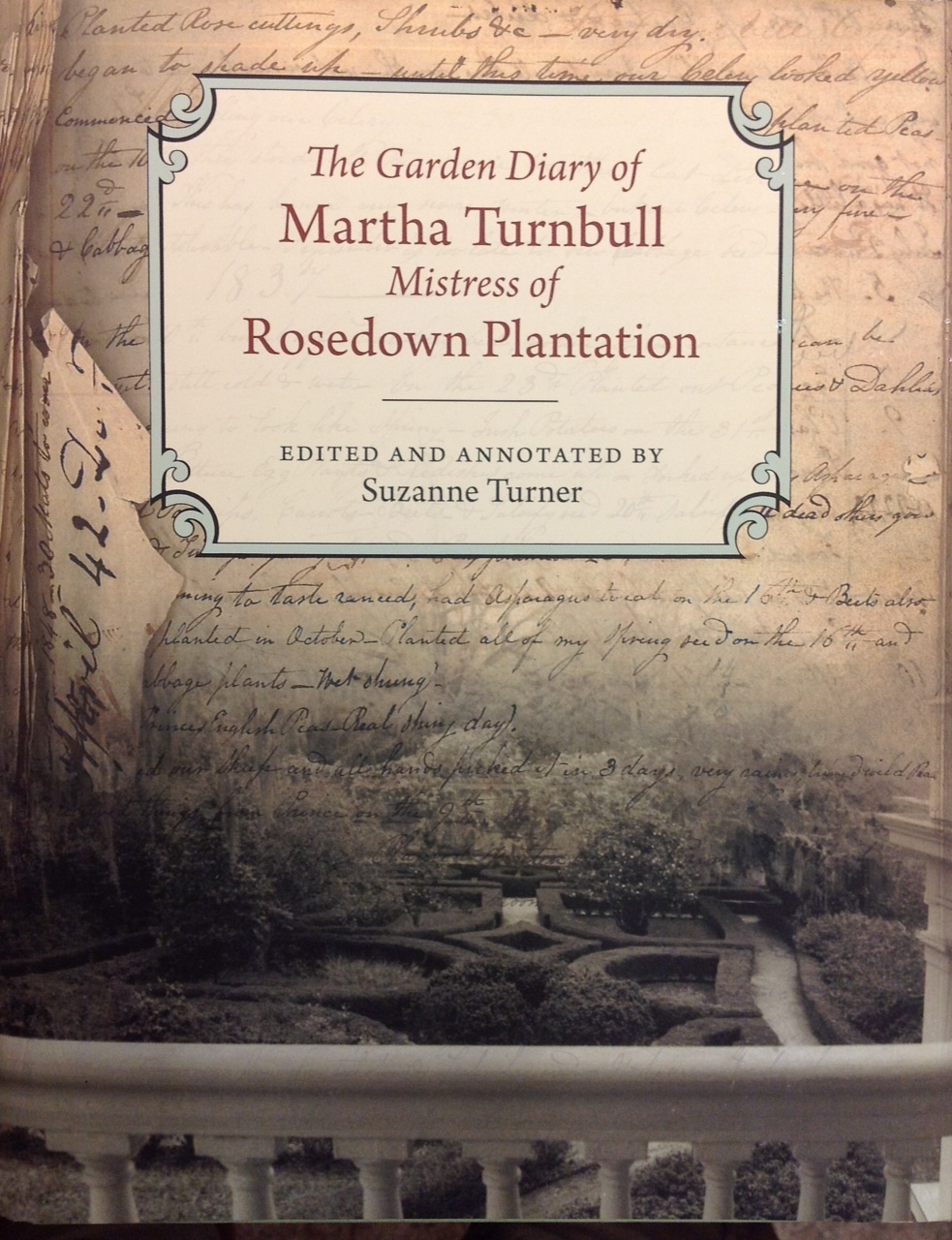
According to a new book, The Garden Diary of Martha Turnbull Mistress of Rosedown Plantation edited and annotated by Suzanne Turner, plants introduced to the area included azalea, camellia, osmanthus, cryptomeria japonica, pittosporum tobira, Japanese quince, Japanese wisteria, and Japanese sweetflag among others.

Martha and her husband Daniel Turnbulls honeymooned in Europe touring the great formal gardens of France and Italy and their influence is still seen at Rosedown. The gardens grew out from the house over a span of many decades, to cover approximately 28 acres. In the 19th century, Rosedown was one of the few privately maintained formal gardens in the United States. Martha Turnbull made purchases from nursery catalogs from the Midwest and East. Plants arrived by river, ocean, railroad and wagon.Invoices indicate azalea and camellia were purchased in 1837 from a nursery on Long Island. During the Depression, Turnbull’s descendants  maintained a small nursery at Rosedown, propagating azalea and camellia plants for sale.

Mac Griswold, landscape historian and author of Washington’s Gardens at Mount Vernon, calls Martha Turnbull “the greatest hands-on gardener of the Deep South.”

Her terse garden journal, cryptic to the point of code, covers the years 1836 to 1894. For 15 years, author Suzanne Turner edited and annotated Turnbull’s garden diary. Turner is LSU professor of landscape architecture emerita and owner of a landscape architecture firm in Baton Rouge.

“When I was teaching at LSU, women kept asking me to give talks on 19th century gardens,” Turner said. “Diaries and journals are rare other than financial records on cotton and sugar cane.”

“She propagated camellias, hedges, roses and evergreen stuff,” Turner said. “She saved vegetable and annual seed. It seems she had a greenhouse from the outset.”

The National Park Service maintains a web site with a National Register of Historic Places. Its travel itinerary notes that Rosedown Plantation was established in the 1830s by Daniel and Martha Barrow Turnbull. Once encompassing 3,455 acres, “Rosedown Plantation is one of the most intact, documented examples of a domestic plantation complex in the South. It embodies the lifestyle of the antebellum South’s wealthiest planters in a way very few other surviving properties can. The plantation’s landscape is a laboratory for the study and interpretation of the cultural traditions of slavery, the life style of the gentry and scientific experiments in agriculture and horticulture,” according to the NPS web site.

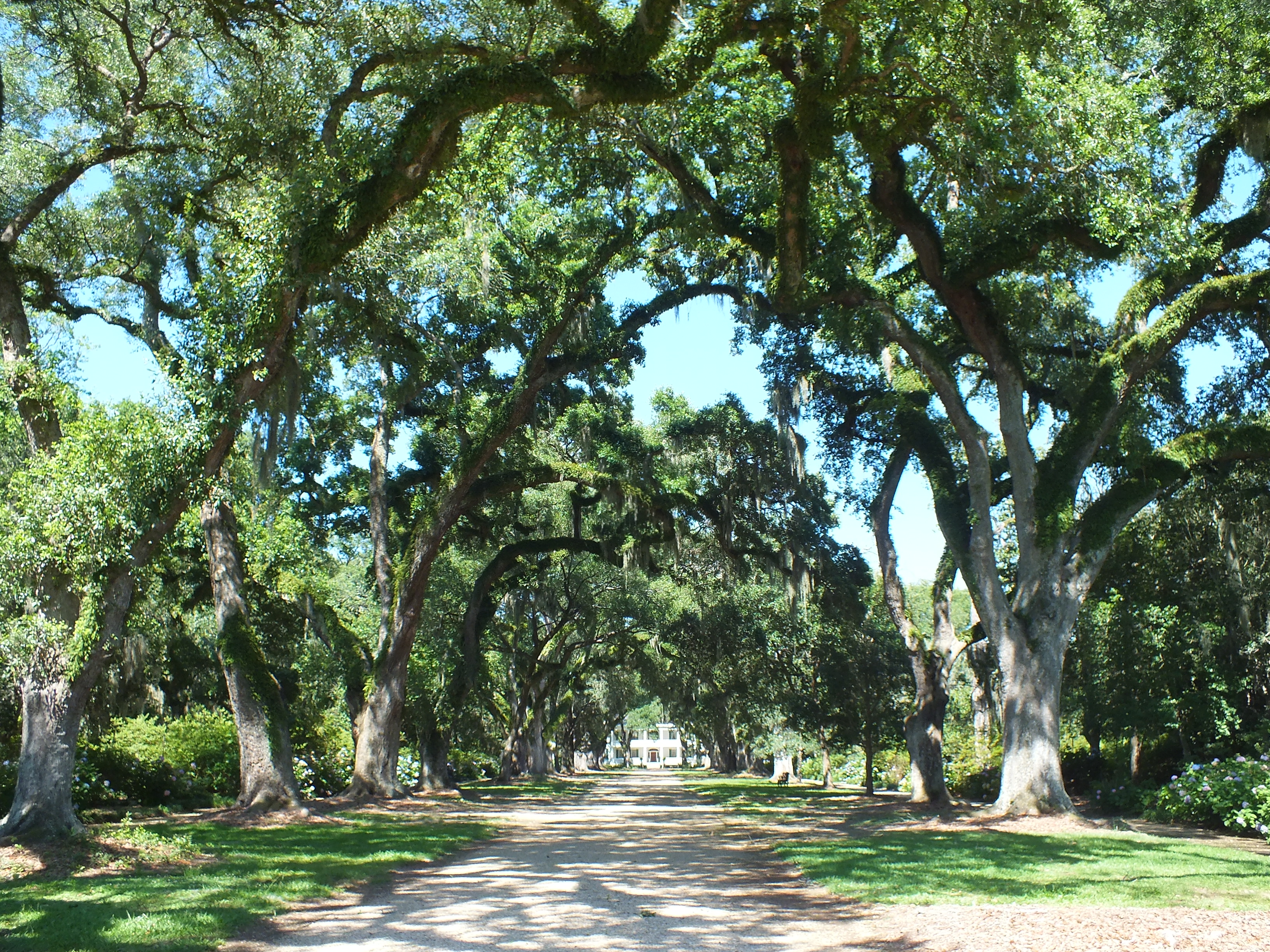
“At its height, the plantation encompassed 3,455 acres, and included the typical components of cotton plantations of the mid-antebellum period in the South–agricultural acreage planted with the cash crop, fields of fodder crops, pastureland for cattle, stables for horses, yards and pens for poultry and other farm animals, the quarters of enslaved Africans (where they typically had their own individual garden plots), a kitchen garden, an orchard, and the pleasure, or ornamental, gardens adjacent to the main plantation house, or the “Great House.” Over the years the acreage was subdivided and although the working portions of the plantation have vanished, both the house and the gardens survive. The c.1835 Federal-Greek revival style great house, complete with Grecian style wings c.1845, is at the head of a 660-foot long oak allee. It is typical of the small minority of great houses built by the South’s wealthiest planters.

the entry allee lined with live oak trees today

“What distinguishes the landscape of Rosedown are its pleasure gardens, notable for their size, sophistication and refined plant collections. The gardens were the passion of Martha Turnbull and her garden diary provides invaluable insight into the story of the garden’s planting and management. She recorded her first entry in 1836 and her last in 1895, a year before her death at the age of 87.”

The Louisiana Office of State Parks owns and operates Rosedown Plantation as a historic site for the purposes of education and preservation. For more information, see http://www.nps.gov/nr/travel/louisiana/ros.htm

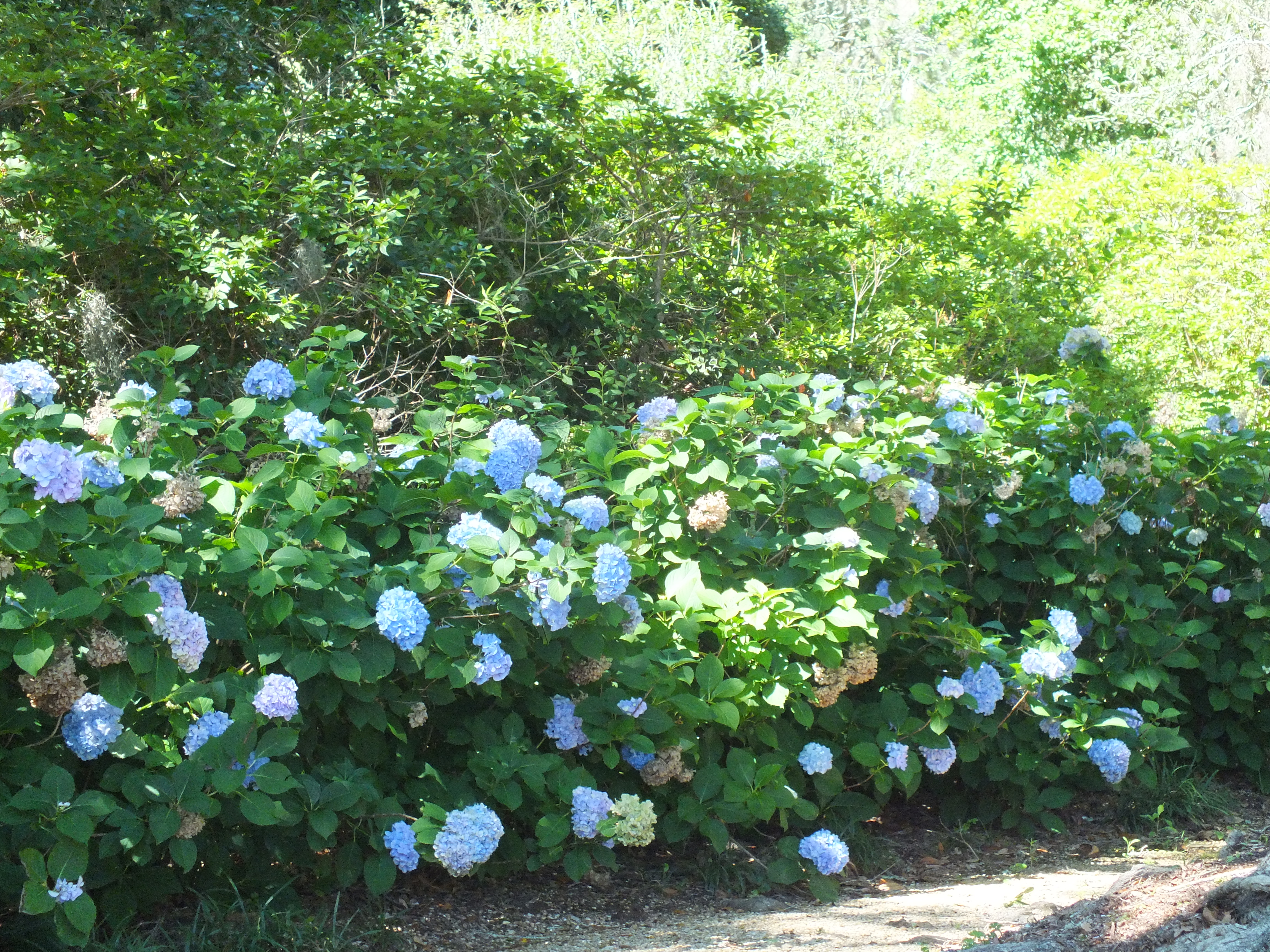
Hydrangeas planted in great drifts form an edge between wilder brush and the huge live oak trees lining the front entrance.

The new publication on Rosedown Plantation is available through your local bookstore, at Rosedown Plantation’s gift shop or on-line from a number of vendors.

A post script:

So Red the Rose

Stark Young’s 1934 novel — wildly popular before Gone With The Wind — opens with a description of the fictional Portobello Plantation, which was based on Rosedown Plantation. Young was a New York Herald Tribune theatre critic who became friends with the sisters who inherited Rosedown.

“Along the avenue the light struck here and there on the statues with their marble pedestals, and on the walks with their green borders; and at the far end you saw the house, on which the last glow of twilight rested, standing out among the garden trees…a retreat, a lovely and secret place, strangely for man and domestic at the same time…the product of romantic feeling and thought.”


Categories: Louisiana, St. Francisville | Tags: , , , | Leave a comment

Blog at WordPress.com.