Author Archives: usjapanesegardens

Unknown's avatar

About usjapanesegardens

Enthusiastic supporter of Japanese gardens; founding member of the North American Japanese Garden Association; founding member Friends of Lili`uokalani Gardens; loves travel and photography

The Westervelt Company in Tuscaloosa, Alabama

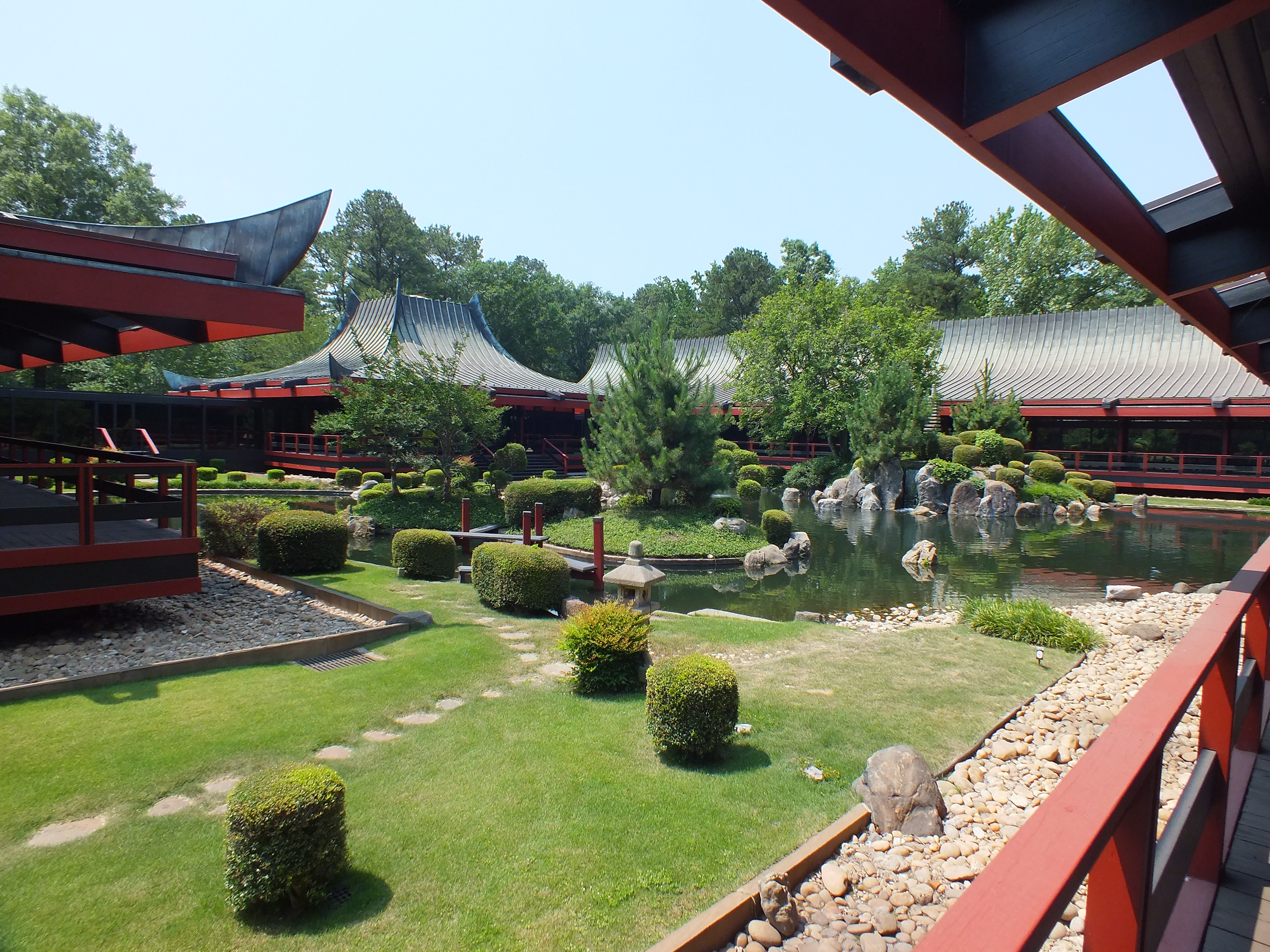
An artful garden sits amid four buildings, the headquarters of The Westervelt Company in Tuscaloosa, Alabama. Formerly known as Gulf States Paper Company, the company’s recently retired president Jack Warner served in Burma during World War II. His time there and his frequent travels to Japan informed the design of the corporate headquarters and garden.

All four buildings are connected by exterior walkways offering varying views of the central garden, inspired by gardens at Katsura Imperial Villa in Kyoto, Japan.

The buildings also house the Tuscaloosa Museum of Art, home of the Westervelt Collection, an extensive collection of paintings, furnishings and sculpture from around the world.

Garden construction began with construction of the office building in 1969 and both were completed in 1972. We were told that Mr. Warner closely directed landscape architect David Engel to achieve his vision — a garden in which quietude brings a sense of the oneness of all: heaven, earth and man. “We begin to feel our relationships to all the universe, where everything is forever changing in form, ever renewing,” according to an old brochure provided by the company.

A company brochure describes this bridge saying: “One legend says that the traditional zig-zag bridge was first built this way so that people on foot could escape their enemies on horseback. Another more practical reason is so the visitor can view the garden from different angles.”

closer view of the waterfall

The entire pond was recently drained and leaks repaired. Koi have not been reintroduced to the pond. Several small goldfish were visible on this visit.

Arrangements to visit the garden and the art collection must be made with the company.

Update from the company: The Tuscaloosa Museum of Art, featuring the Westervelt Collection, will be permanently closing effective Friday, August 31, 2018. Thank you for your support and patronage of the Museum.

Categories: Alabama, Tuscaloosa | Tags: , , , , , , | 5 Comments

Birmingham Botanical Garden

Stone arrangements in Long Life Lake were done by Masaji Morai. A grove of  black bamboo is visible to the left of the bridge. To the right of the bridge is a large lantern, a gift from Hitachi in 1985

From the web site of the Birmingham Botanical Garden:

“Officially opened by the Japanese Ambassador to the United States in 1967, this 7.5-acre site is actually an interwoven collection of gardens built in the Japanese style, replete with traditional architectural and garden elements. Here you can find the tea garden, the karesansui garden with its meditative compositions of boulders set amidst a bed of raked gravel, the hill and stream garden* with features such as the Seven Virtues Waterfall, and the small stroll garden set around Long Life Lake. Casual visitors will want to study the colorful koi, relax in the lakeside rest shelter, or take a class at the cultural pavilion. Plant lovers will enjoy exploring bamboo groves, examining our growing collection of momiji – the Japanese maples – and seeing prehistoric dawn redwoods.

“Designed by Mr. Masaji “Buffy” Morai, the Japanese Gardens officially opened in 1967 and have been one of BBG’s most popular features since then. Largely through the hard work and guidance of volunteer Doug Moore, major modifications to a large part of the gardens were finalized in 1993 when the Japanese government gave it the title of Japanese Cultural Center. That important designation was made because Mr. Kazunori Tago, of Maibashi, Japan, one of the finest miyadaiku, or Japanese temple and shrine builders, created a traditional tea house here. Toshinan, whose name means, “the house where those gathered can light a wick [of understanding] in each others’ hearts”, is a 16th-century Sukiya-style tea house, made completely from materials brought from Japan and built using only traditional tools and techniques. There are fewer than a dozen such structures in the United States, and none are finer than Toshinan. An adjacent yoritsuki, or waiting hut, was also designed and built by Tago-san, completing the tea garden structures. Materials were donated by the citizens of Maibashi and additional funding was provided by the Shades Valley Council of Garden Clubs and Gardens of Inverness; the yoritsuki was dedicated in honor of Eva Woodin Gambrell. Members of the Japanese Garden Society of Alabama assist with maintenance of the tea house and in cultural and educational programming.

“The Japanese Gardens are entered through a spectacular curved-top torii, or “gate to heaven”, painted a traditional bright red. This area was renovated and the master plan updated in 1988 through funds given by the Drummond Company in memory of Elza Stewart Drummond. Down the path from the torii, a tile-capped mud wall is punctuated by the entrance to the Cultural Center: the Taylor Gate, given by Dr. Wendell Taylor, with its heavy, yet intricately joined, wooden timbers. Across the stream from the tea house sits the Japanese Cultural Pavilion, which is based on the design of a rural Japanese theater. Three sides of the pavilion are removable, facilitating seasonal open air activities like classes such as sushi-making, performances such as martial arts demonstrations, and many other aspects of Japanese culture.

“A recent update of the master plan for the Japanese Gardens was completed by Zen Associates of Sudbury, Massachusetts. The firm’s principal landscape architects, Shinichiro Abe and Peter White, have an intimate knowledge of Japanese garden design and construction, and as their company’s name suggests, it is their sole specialty.”
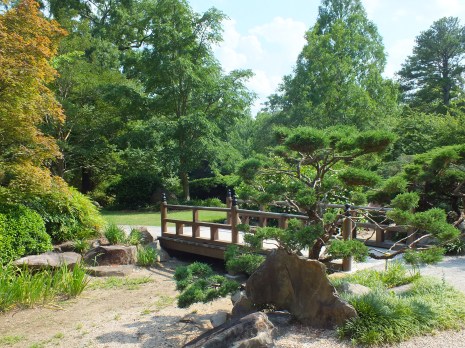
The new View Receiving bridge designed by Zen Associates will accommodate maintenance vehicles and is barrier free. It spans the water course, dry for several years, which is on the list for repair. The bridge marks a transition from a more tightly planted area to more open plantings.

New beds of azalea are being installed as part of that master plan. Renovations and repairs are planned throughout with perhaps the largest efforts being restoration of the watercourse and the addition of an ampitheatre behind the cultural center. New maples are being added and a walkway through the bamboo thicket is planned.
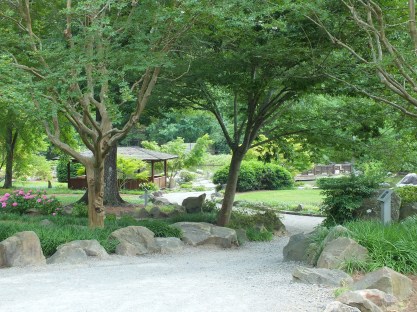
Pink hydrangea were in bloom beyond the View Receiving bridge.

The Birmingham Botanical Garden comprises 67.5 acres, 7.5 of which are the Japanese garden. The BBG is owned by the city which has an agreement with the Friends. The City handles outside reservations such as weddings. The Friends organization handles education, fundraising, capital improvements, and special events. BBG has the nation’s largest public horticulture library. The garden is open free to the public all year long.

For more on the Birmingham Botanical Garden, visit their web site:

Welcome
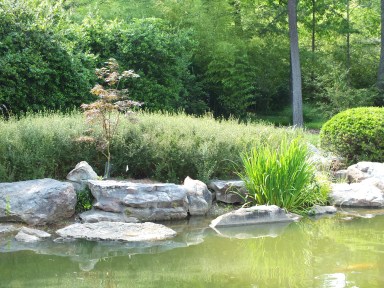
New varieties of maple are going in on the far side of the lake.

Many thanks to Fred Spicer Jr. for the “grand tour” via golf cart and for the wealth of information shared.

When you visit this garden, be sure to stop in Leaf and Petal, the shop at the entry, for a wide variety of art, crafts, garden items and plants. There’s always news about garden tours and classes available there and on the web site.

Categories: Alabama, Birmingham | Tags: , , , , , , , , | 2 Comments

The Carter Center and The Jimmy Carter Presidential Library and Museum

Located about two miles from downtown Atlanta are The Carter Center: Advancing Human Rights and Alleviating Suffering and the Jimmy Carter Presidential Library and Museum, two separate entities on Freedom Parkway. At the heart of these buildings is a large garden, part of which is a Japanese garden designed by Kinsaku Nakane and donated by the YKK Corporation. The garden contains many species of azalea, rhododendron, Japanese maple. river birch, camellia, golden raintree and barberry. The garden is open from 6 a.m. to 9 p.m. daily, although access through the library building must wait until opening hours.

This vantage point is at the farthest edge of the large, lower pond looking back toward Kinsaku Nakane’s waterfalls. The Jimmy Carter Presidential Library and Museum building is visible at the upper right.

The larger waterfall visible behind the lantern is dedicated to former President Jimmy Carter and the smaller to his wife Rosalyn, according to a garden brochure.

Categories: Atlanta, Georgia | Tags: , , , | 1 Comment

More on the Atlanta Botanical Garden

This information comes from Amanda Campbell, horticulturist at the Atlanta Botanical Garden.

“In the 1960s the Atlanta Bonsai Society began a Japanese Garden which was largely a collection of bonsai plants. It was a charming and restful little garden, but it was eventually vandalized and the bonsai were stolen, so the Bonsai Society gave it up. In 1980 the Japanese Garden was restored as part of the Atlanta Botanical Garden. Initially the Japanese Garden had no water, and white sand was used to form “pools”. In a 1984 renovation, water replaced the sand. In 1996-97 the garden was renovated once again by a generous gift made possible by the Bonsai Society, the Cherokee Garden Club, the Ivy Garden Club and Mrs. Ferst. The structures, including the stone wall, were designed and constructed by Toshihiro Sahara.

“The design combines several styles of traditional Japanese gardens, including elements of a hill-and-pond garden, courtyard garden and tea garden. The chozubachi stone basin is used in a purification ritual before the tea ceremony. It is placed on the ground so that one must crouch over it to rinse the hands and mouth, therefore humbling and clearing the mind.  The machiai (pronounced mah-chee-eye) or tea garden waiting bench is a place to rest, reflect, and enjoy the garden.

“The Japanese Garden is basically a monochromatic garden; nearly everything is green, with variation of texture and shading. Color is used sparingly to highlight seasonal change – irises and azaleas bloom in spring, maples change color and drop their leaves in the fall. However most of plants used are evergreen.  Reverence of nature is the guiding philosophy in Japanese gardening. The main garden primarily contains plants from Japan, while the surrounding gardens highlight interesting plants from all over Asia.

A sweetly subtle way to acknowledge a donor — the name is inscribed on a stepping stone leading to the machiai.

“A collection of harp-string nandinas, or kinshi nanten, were added during the 1997 renovation.  These rare cultivars were popular in Japan from the 1600s to the 1800s. Also of interest are a number of dwarf conifers and Japanese maples. The large pine tree is a Virginia scrub pine, Pinus virginiana. It is planted and trimmed to give the appearance of great age. Other noteworthy trees include the weeping Japanese persimmon, Diospyros kaki, in the corner, the Stewartia monadelpha against the fence, and the weeping Japanese snowbell, Styrax japonica, next to the east gate. On the right are two groupings of Equisetum hyemale, or horsetail. This prehistoric plant is related to ferns, but it is not a fern and has no leaves or fronds. It reproduces by spores and spreads underground like bamboo.

“The Moon Gate, typically a feature of Chinese Gardens, was completed in 1985. When the moon gate was built it was necessary to cut the round window in the back of the machiai because it is essential to have a vista through the gate. Twice blooming Autumn Encore azaleas have been planted here. They bloom in spring and fall.

“The large lantern at the southwest entrance (near the hydrangea garden) is over 300 years old.  It was donated by Minaminippon Broadcasting Co. in Kagoshima, Japan, Atlanta’s sister city, in 1963.”

lantern by the back gate

The horticultural staff maintains the Japanese garden, contracting out a few chores. For example, the gate to the tea house was removed and sent out to repair termite damage.

Toshihira Sahara mentioned above not only ran Architectural Woodworks in Atlanta, but also served as minister for a small Japanese congregation.

Categories: Atlanta, Georgia | Tags: , , , , , , | Leave a comment

Atlanta Botanical Garden

The Japanese garden now incorporated in the 30-acre Atlanta Botanical Garden predates ABG by many years. It is the oldest part of ABG. A small sign inside the entry path notes the Japanese garden is undergoing renovation.

The Japanese Garden Research Network notes that pruned pines in this garden are Virginia pines, Pinus virginian. Maple, azalea, bamboo, and iris are among many plants inside and adjacent to this small walled garden.

The July 2011 issue of Southern Living contained an article on the entire ABG and 2010 expansion that doubled its area to the present size. http://www.southernliving.com/travel/south-east/what-to-do-at-atlanta-botanical-garden-00417000074415/

Moon gate just outside the Japanese garden at Atlanta Botanical Garden with a pruned pine to the right of this photo. A small lantern tucked into the greenery at the beginning of this path is featured later in this post.


Perpendicular to and beyond the Moon Gate to its right is another entry. This view shows two of the three walls (at the right) enclosing the garden.

Inside the walls, a waterfall and stream course by blooming iris and clipped azalea then pass under a small curved stone bridge.

Some of the recently completed renovations…

a small lantern tucked in to the greenery near the entry path leading to the Moon Gate

maple near the machiai

Categories: Atlanta, Georgia | Tags: , , , | Leave a comment

The Grand Hyatt Atlanta in Buckhead

Walk through the gleaming brass doors, held open by a genuinely friendly staff member, and the first thing that will catch your eye is the three story waterfall designed by Takeo Uesugi of TUA Inc. I perused the landscape architect’s site before coming here to Atlanta. You may see more of Mr. Uesugi’s work at http://www.tuainc.com/ especially in the portfolio section of the site. A little more detail on Mr. Uesugi’s life and work is available in a Wikipedia article: http://en.wikipedia.org/wiki/Takeo_Uesugi

We first became acquainted at the International Conference on Japanese Gardens Outside of Japan held in Long Beach, California, in March 2009. I have seen Mr. Uesugi’s work in Long Beach, San Diego, Pasadena, Los Angeles, and Malibu, but this was my first visit to one of his garden designs outside of California. This garden opened with the hotel in 1990 when it was the Hotel Nikko. Hyatt purchased the property in 1997 and put $5.6 million in to renovations in 2000.

The waterfall at the Grand Hyatt Atlanta is visible from the lobby, the Onyx Bar, the Cassis restaurant on a level lower than the lobby, from windows in a hallway connecting the elevators on the third floor to the pool area, from the pool area and a veranda outside the elevator area on the third floor and from several rooms facing that side of the hotel. It drops from a flat area that includes a small garden with several typical features: trimmed shrubs, tsukubai, bamboo thicket, machiai, dry  stream bed, and well arranged stone work.

The waterfall cascades from the third floor pool level, divides in two and lands in a pool with a rock beach on a small island with a maple and a lantern set in the pond. The pond is surrounded by plantings of pine, azalea and bamboo.

View from the third floor veranda at the top of the falls, looking toward the table from which the previous image was taken.

The view immediately to the right of the previous image: The third floor veranda leads to one entry to the small garden. The other entry is from the pool side refreshment area.

Update 2016: It is with deep sadness that we report Takeo Uesugi died 26 January 2016 at his home in California following a battle with cancer. He was 75 years of age. A link to an obituary in the Los Angeles Times listing his many achievements follows. Our heartfelt condolences to his family and coworkers.

http://www.latimes.com/local/obituaries/la-me-takeo-uesugi-20160218-story.html

Categories: Atlanta, Georgia | Tags: , , , , , , , | 2 Comments

a private garden tucked away in the woods

Atlanta is a beautiful city featuring a green canopy of established trees in many areas. Some residents have chosen to augment their woods. The owner of this property designed this garden, moving many established maple trees from his previous property some 15 years ago.

Image

This magnificent lantern is quite tall, setting the scene in the entry garden.


Image

A small bridge crosses a stream between the driveway and the main entrance to the home. Perfectly clipped bushes and a collection of maples highlighted the soothing atmosphere of this front yard.


Image

Near the front door, a rustic wooden bench provides a resting spot to enjoy all the details of this area by the front door.


Categories: Atlanta, Georgia | Tags: , | 2 Comments

at last! a computer connection and Lush Life Home and Garden photos are available

Japanese Sunrise is one of many maples offered by the garden division of Lush Life on Andrews Avenue in the Buckhead area of Atlanta.

We learned the other day in Atlanta that our iPad would not support upload of photos to this blog. Aaack! And the Dell PC suddenly decided it could receive e-mail but not send any replies. Double Aaack! So here we are in Fayette Alabama outside Birmingham with some things working again. Must be the company of long-time good friends.

Here are a few photos of our visit to Lush Life Home and Garden at 146 Andrews in the Buckhead area of Atlanta, not too far from where we stayed at the Grand Hyatt in order to see Takeo Uesugi’s garden there.

The boutique offers “sophisticated and stylish decor for inside and outside the home” and a fabulous selection of plants perfect for Japanese gardens including many unusual maples.

Check out their web site at: http://www.lushlifehomegarden.com

Lush Life entry

In the Buckhead area of Atlanta, we visited a garden and floral shop, Lush Life. The abundant nursery compliments the delightfully appointed showroom. The owner’s personal garden was part of the Atlanta Botanical Garden’s tour over the Mother’s Day weekend. Bill Hudgins was traveling in London for the Chelsea Flower Show. His personnel were most helpful.

There was something to see and admire at every turn through the well appointed shop, Lush Life on Andrews in Atlanta’s Buckhead area.

The terraced back yard behind the shop offers a variety of indoor and outdoor plants, jardiniere, garden ornaments and trellises.

parking and demonstration plantings in front of Lush Life in Atlanta — store hours are 9 a.m. to 5 p.m. Monday through Saturday

Categories: Atlanta, Georgia | Tags: , , , | 1 Comment

On the road

Walking through the San Francisco airport, we noticed emblems from several Sister Cities projected on the walkway. This lotus is from Bangalore.

Categories: California, San Francisco | Tags: | Leave a comment

More photos from Lili`uokalani Gardens in Hilo, Hawaii

Dennis Makishima demonstration

Dennis Makishima demonstrated pine tree pruning at Liliuokalani Gardens in Hilo to County workers and Master Gardeners April 2011.


Still learning how to format and layout text and photos. Here are a couple of photos from Dennis Makishima’s visit to the Big Island in April 2011.

Photos not otherwise credited are by K.T. Cannon-Eger. Click on any image to see it full size.

Dennis Makishima demonstration

County workers and Master Gardeners listen to Dennis Makishima before beginning several projects. photo by Bill Eger


A recent sunny day in Hilo at the zig-zag path leading to the red bridge…
photo by Bill F. Eger 2012

UPDATE: This 2012 view by Bill F. Eger was the basis for graphic art used for the 2017 Priority Mail stamp. This was the first U.S. stamp to feature a Japanese garden. It was Hilo’s first time on a stamp.

Short N Sweet Bakery and Cafe on Kino`ole Street in Hilo created the tasty cake made to look like a first day of issue envelope [photo by K.T. Cannon-Eger]

Categories: California, Hawaii, Hilo, Oakland | Tags: , | Leave a comment

Blog at WordPress.com.