Author Archives: usjapanesegardens

Unknown's avatar

About usjapanesegardens

Enthusiastic supporter of Japanese gardens; founding member of the North American Japanese Garden Association; founding member Friends of Lili`uokalani Gardens; loves travel and photography

The trip West continues

A more extensive article on Chicago’s Osaka Garden at Jackson Park will be posted soon. By 2013, the garden was re-named The Garden of the Phoenix.

Osaka Garden pond and bridge

Osaka Garden pond

Osaka Garden at Jackson Park in Chicago dates from the 1893 World’s Columbian Exposition. It was recently renewed due to the efforts of an active Friends group with the expertise and guidance of Sadafumi Uchiyama and the cooperation of the Chicago Parks Department.

Meanwhile, here are a few photos from the rest of the journey from Chicago to Denver to San Francisco by train.

Here, we have included images from gardens in Chicago, Denver, Grand Junction, Berkeley, Oakland, Orinda and San Francisco to give you a little taste of the articles still to come.

Denver pond

Looking in one direction, Shofu-en displays one of the inspirations for its name — “Garden of the Pines and Wind.”

Denver Shofu-en

Looking across the pond in another direction, one could feel transported to similar gardens in urban Japan. The residents of the nearby condos must enjoy a beautiful view.

Grand Junction

Entry to the Japanese garden in Grand Junction, Colorado, is through a conservatory with plants familiar to many in Hawaii and other tropical regions.

Berkeley Botanic

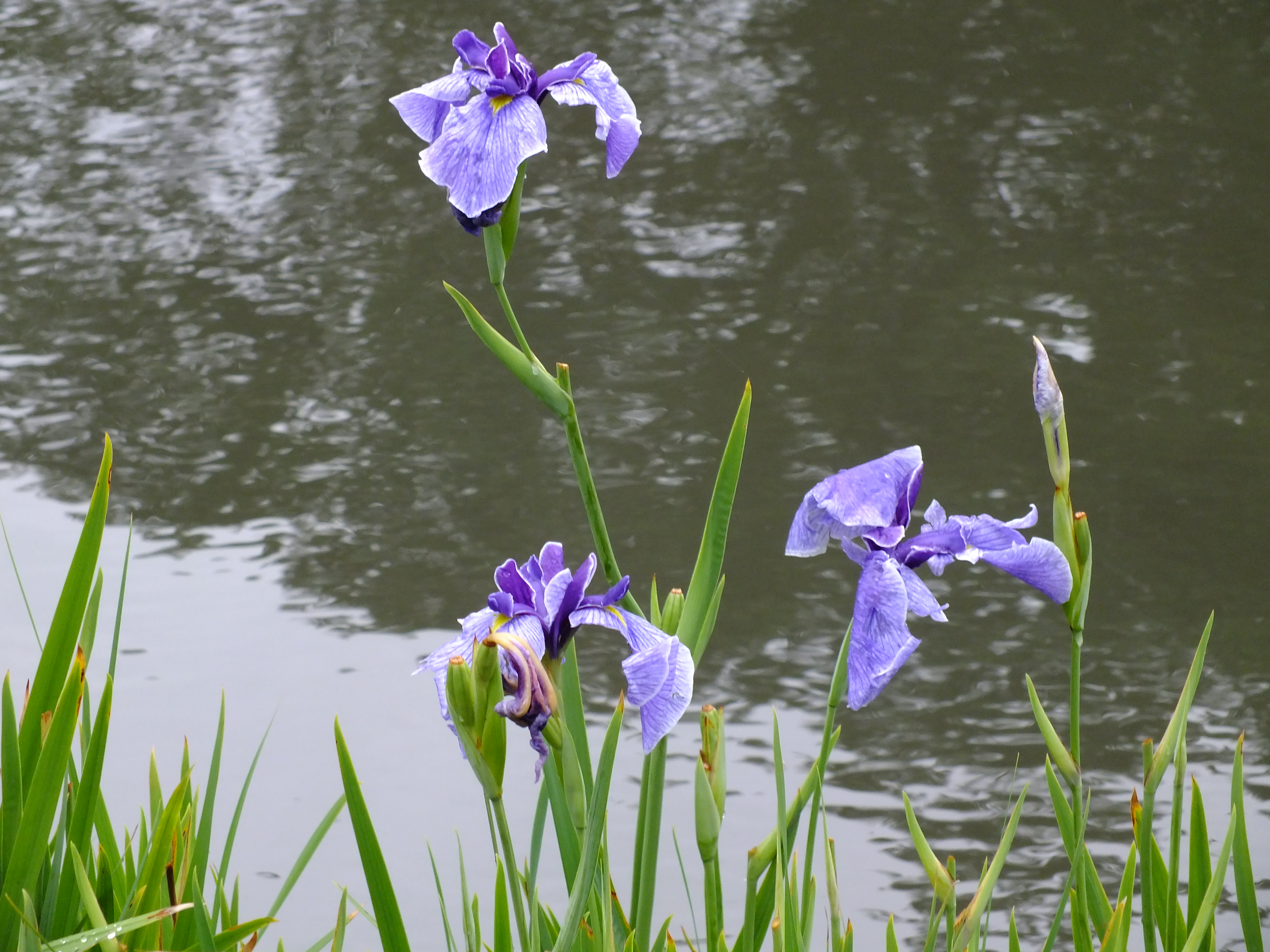
This is a small section of the pond in the Japanese garden at UC-Berkeley Botanical Garden. Iris were in bloom throughout our journey in June.

Higashi Hongwanji

The Higashi Hongwanji in Berkeley (www.bonbu.com) has an elegant entry garden maintained in part with the assistance of the Aesthetic Pruners Association.

Oakland

Every detail matters — and here a relatively new stone appears to have been in place for hundreds of years due to the lichen.

borrowed scenery

The living room is arranged to take full advantage of the garden in this private residence in northern California.

WF entry

A rooftop corporate garden in San Francisco, created some years ago, was completely redone recently to address engineering problems that developed over the years. This is a small detail of an area separating the entry door, which leads to the garden, from a walkway that goes around the roof.
(photo by Bill F. Eger)

San Francisco
Ginkgo leaves near the 1915 pagoda at the San Francisco Japanese Tea Garden

To see a full size version of any photograph in this blog, just click on the image.

Categories: Berkeley, California, Chicago, Colorado, Denver, Grand Junction, Illinois, Oakland, San Francisco | Tags: , | Leave a comment

Chicago Botanic Garden in Glencoe: where East meets Midwest

“The Japanese have taken their love of growing things and their realization of man’s union with nature and refined them in the beauty of their gardens. The purpose of a Japanese garden is to present natural forms and to create a tranquil beauty that leads the visitor from everyday life to a calm, serene, reflective communion with nature.”

Koichi Kawana

color and texture

shades of green and varieties of texture
(photo by Bill F.Eger)

Sansho-en at Chicago Botanic Garden is a 17.3 acre promenade style garden or kaiyu-shiki, a garden style developed during the 17th century. Sansho-en means “The Garden of the Three Islands” – Keiunto, Seifuto and Horajima – visible in a diagram of the garden. The experience in a stroll garden is to see the garden while walking. Different views appear on the journey along a winding path.

map of three islands

map of the three islands of Sansho-en courtesy of Chicago Botanic Garden

“A walk through Sansho-en reveals a collection of smaller gardens and classic elements from several historical Japanese garden styles,” said one garden brochure. “In Sansho-en you can experience contemplative dry gardens, an intimate moss garden, cool woodland gardens and a distant paradise garden, all in one visit.”

karesansui

contemplative karesansui (dry landscape)
(photo by Bill F. Eger)

intimate moss garden

intimate moss garden by the Shoin House
(photo by Bill F. Eger)

a cool woodland

a cool woodland with azalea hillside
(photo by Bill F. Eger)

a distant paradise island

distant paradise island seen from the entry bridge
(photo by Bill F. Eger)

Dr. Koichi Kawana (1930-1990) designed more than a dozen major Japanese gardens in the United States, including Seiwa-en at the Missouri Botanical Garden and Shofu-en at the Denver Botanic Gardens. In addition, he was a professor at the University of California, Los Angeles, where he lectured on Japanese art, landscape design and architecture. Dedicated in 1982, Sansho-en celebrated its 30th birthday the day we visited in June.

Elizabeth Hubert Malott Japanese Garden dedication plaque

dedication plaque for Elizabeth Hubert Malott Japanese Garden reads: “Her childhood years in the Orient fostered a lifelong respect for and love of Japanese culture and landscape.”
(dedication 2006; this image 2011)

Sansho-en also is called the Elizabeth Hubert Malott Japanese Garden. An endowment was created for the Elizabeth Hubert Malott Japanese Garden through a gift from the Malott Family Foundation in 2006, when the garden was re-dedicated. Income from the endowment will provide funds to maintain the Japanese Garden and provide programs that teach visitors about Japanese culture and history.

Mary Plunkett travels by cart.

Mary Plunkett travels by maintenance cart between gardens on a busy day.
(photo by Bill F. Eger)

Mary Plunkett is manager of Interpretive Programs at Chicago Botanic Garden and oversees seven gardens. There are nearly 200 interpretive volunteer positions throughout Chicago Botanic, 20 in the Japanese garden.

Plunkett came to Chicago Botanic Garden 11 years ago with a background in volunteer management. “Nobody comes here to give poor information. Everyone comes with a good heart and desire to be helpful to our curious visitors, so my job is to encourage and inform them,” Plunkett said. “A volunteer generally is here two times a month. If you want a good volunteer program you have to have staff to support them. We are so lucky to have that support.”

“Our volunteers are here Wednesday through Sunday through the first weekend in October. We track nearly 35,000 visitor encounters during a season,” Plunkett said.

display of carpentry tools and karesansui rake

tools display: carpentry tools on the board and karesansui rake leaning against the board at a NAJGA regional meeting in 2011

Volunteers have an extensive document of information, history, tool identification and frequently asked questions for training and reference. A board to which various tools are attached aids in explaining their uses.

tool board detail

detail of tool board

tool board detail

descriptive text for the sumitsubo (ink pot)

“Volunteers can be a driving force in the garden,” said senior horticulturist Benjamin Carroll. “They have such enthusiasm. It’s really important for us to recognize their work and express gratitude regularly.”

Edie Rowell at Shoin House

Edie Rowell prepares to open Shoin House
(photo by Bill F. Eger)

Edie Rowell is in her fifth season as a garden volunteer. She spends one day a week in the Malott Japanese Garden and one day “digging in the fruit and vegetable garden.”

“Visitors do not go inside the Shoin House. We speak to them from the engawa, explain the construction, tools, type of garden and so forth,” Rowell said. “This is not a tea house. Tea houses are usually smaller – four and a half to six tatami size. This is a 23 tatami house. Shoin rooms started out as the study of Buddhist monks. The style morphed into the Camp David of its day – a man cave for a very high ranking man, a retreat house for a daimyo where one’s equilibrium could be restored.”

volunteer on the engawa of Shoin House

a volunteer encounter with visitors to Shoin House
(photo by Bill F. Eger)

Benjamin Carroll in the tool shed

Benjamin Carroll demonstrates placement of a peg to which twine is attached to shape trees.
(photo by Bill F. Eger)

The senior horticulturist at Chicago Botanic Garden, Benjamin Carroll obtained his B.S. in horticulture, Writtle College in Essex, England. Carroll was employed for two years at Cambridge University Botanic Garden before joining the Chicago Botanic Garden staff. He is a director-at-large for the North American Japanese Garden Association (NAJGA).

gift shop at Chicago Botanic Garden

Chicago Botanic Garden gift shop in the Visitor Center
(photo by Bill F. Eger)

Chicago Botanic Garden’s facilities are truly delightful. The Visitor Center adjacent to the parking area offers an extensive and well stocked gift shop on the right, an abundant café on the left, an information desk and “Ask A Master Gardener” service. Educational classes, children’s programs, seasonal displays, and membership benefits are a few of the many offerings.

Chicago Botanic Garden offers 25 gardens on 385 acres. Roughly 60 acres are covered by water. There is no admission charge for Chicago Botanic Garden. There is a fee for parking. To plan your visit, check out the web site for hours, directions, parking fee, transportation, what’s in bloom, etc.

http://www.chicagobotanic.org/visit/

To see a 7 ½ minute video in Malott Garden uploaded by Benjamin Carroll to You Tube in 2009, visit:

http://www.youtube.com/watch?v=sQtay6II840

one example of the bonsai collection

Near the Regenstein Center, a bonsai collection is displayed in outdoor courtyards.

bonsai courtyard on a sunny day

CBG cafe

in the cafeteria, a sign in a table arrangement of potted herbs reminds one of various ways to contribute to the Chicago Botanic Garden

For other planting tips from Benjamin Carroll, check out the following short stories:

Benjamin Carroll planting bulbs

http://www.youtube.com/watch?v=5_6g7BtY06I

WGN-TV interview on houseplants during the winter

http://www.wgntv.com/videogallery/66815502/News/Benjamin-Carroll-from-the-Chicago-Botanic-Garden-answers-your-questions

Hope for healing the planet

http://www.youtube.com/watch?v=hcUoX5kAcbU

Photos not otherwise credited are by K.T. Cannon-Eger. Click on any photo to see a full size image.

bridge with seasonal floral display

the entry bridge between the Visitor Center and the Crescent Garden in fall

bridge with seasonal floral display

the bridge between the Visitor Center and the Crescent Garden bedecked with summer blooms

Categories: Glencoe, Illinois | Tags: , , , , , , , | Leave a comment

Serenity Garden offers a healing environment

Whispering Woods Serenity Circle
(photo by Bill F. Eger)

“We all need a place where we can get away from the hustle and stress of life, a place of peace and tranquility. When we find that place, we find strength. The Rosecrance Serenity Garden is such a place. These gardens are meant to be a part of the healing process offered by this incredible facility where miracles happen,” stated John Anderson, philanthropist.

Serenity Garden is located on the grounds of the Rosecrance Griffin Williamson Campus, an adolescent treatment center in Rockford, Illinois. The new 50 acre campus, which opened in 2004, includes this six acre garden designed by Hoichi Kurisu to provide a healing environment to nourish ongoing recovery for youth and their families.

welcoming waterfall near the entrance — a feature sometimes not noticed when a person enters treatment, but frequently noticed when they leave

Through the Experiential Therapies Department, the garden is used for guided meditation to help adolescents relax and reflect on recovery. Every week, the young people become aware of their basic senses: sight, sound, taste, touch and smell.

It is the setting for family visits, individual counseling, private journaling and other contemplative activities. The overall objective of horticultural therapy is to cultivate physical and emotional stability and spiritual awareness through nature in a structured environment.

K.T. typing one-handed on her iPad while interviewing Christine

“This garden is designed around the healing qualities of a Japanese garden integrated with the 12 steps of recovery,” said Christine Nicholson, Experiential Therapies Supervisor.

“Each week we deal meditation techniques designed to teach our young people how to be at peace with the calm and ‘boredom’ known as serenity.

“One week I might ask them ‘What kind of water are you?’ which always gets them going. Raindrop, waterfall, ocean wave – it’s a way to get them thinking about the world outside their heads,” Nicholson said.

cedar Serenity Bridge, #6 on the map
(photo by Bill F. Eger)

Being in a garden with streams, waterfalls and a large pond offers several examples as well as an abundance of locations for group and solitary activities. Kurisu describes boulders as the garden’s bone structure and water as the lifeblood running through it.

“As you stand on the deck, you view the action of the waterfall. We watch it come down to the calm surface and feel the serenity of the pond. It reminds us that we are never alone in the universe,” said Kurisu.

Cascading Waterfall, item #9 on the map

“Another week, I may say, ‘You are the earth. How do people walk on you? As the earth, how do you give to people,” Nicholson said.

“One teenager described the activity of raking gravel as ‘massaging my brain’.”

bell used in graduation ceremonies, item #5 on map
“Life’s Waiting” carved in stone at the base of the bell tower is the motto of Rosecrance.
(photo by Bill F. Eger)

A graduation ceremony involves ringing the bell in recognition of the ancient tradition of seeking purification within a sacred place and the desire for a balanced life. A new element of crossing the bridge will be added to graduation ceremonies, according to Nicholson.

Healing Garden Tour [text and map courtesy of Rosecrance]

1. Wooden bridge: this is where an Acer palmatum dissectum adds a splash of red to an otherwise green palette.

Acer palmatum dissectum recently trimmed
(photo by Bill F. Eger)

2. Courtyard and serenity circle: Serenity circles are places where residents, families and visitors can pause to reflect and view the garden. This is the largest and most formal of the serenity circles. The stream running through the courtyard makes 12 drops (for the 12 Step Program) before reaching the pond.

3. Winding walk: Curves in the path remind users that the journey is not straight and life reveals itself slowly. At the peak of the walk is Peaceful Passage Serenity Circle.

4. The pond: The pond, which is 13’ deep at the center, is supplied with both rain and city water. Koi, bluegill and bass thrive in the pond. From the landing, you can take in the full scope of the pond, formal garden, mountain waterfall and natural forest backdrop.

5. Bell tower: When an adolescent successfully completes treatment, the bell is struck as an announcement to the community.

6. Serenity bridge: This bridge is pitched like a mountain because one must work to get to a better place. The use of cedar, an aromatic wood, engages another one of the senses.

Similar to the flagstone bridge mentioned in #7, this bridge is in the #2 courtyard.
(photo by Bill F. Eger)

7. Open stone bridge: The flagstone walkway over the river is deceptive to the eye, giving the appearance of being fragile, but holding great strength.

# 8 on map, Stepping Stone bridge

8. Stepping Stone bridges: At the top and bottom of the waterfall, a stepping stone bridge invites you to cross the flowing water safely. This fall also makes 12 drops before a final plunge into the pond.

9. Cascading waterfall: In the style of a Japanese garden, water in our Healing Garden flows only in a way that is totally natural. Anchored by a 40-ton boulder, the large waterfall moves more than 1,200 gallons of water per minute. The falling water strikes the stones in three locations, adding depth of sound. A “guardian stone,” the protector of the garden, juts out of the pool at the waterfall’s base.

10. Grateful outlook: The highest point of the garden represents the top of the mountain. To observe the natural woods beyond the garden, you must look through the evergreen trees, which form a natural frame for the scene. Note how the sound of the waterfall is muffled by the stones.

weeping willow at the tip of the peninsula
(photo by Bill F. Eger)

11. The peninsula: The peninsula is a reminder of the island nation of Japan where water and land intertwine.

12. Cobblestone bridge: Water from the winding river flows under the bridge to the tranquil pond.

minimally structured path into the woods
(photo by Bill F. Eger)

Healing Gardens

“A healing garden is a natural space that has a therapeutic effect on those who are open to the experience. In a healing or serenity garden there is a deliberate acknowledgement that not all healing is the result of medicine or treatment. Sometimes it comes from unexpected places such as through a connection to the natural world. The elements of the garden engage all of our senses. They offer a positive distraction to everyday life, encourage interaction and provide a connection with nature’s rhythms.” From Rosecrance Serenity Garden overview.

“There is a tremendous grace and energy inherent in such ancient rhythms,” said Kurisu. “At once calming and exuberant, the natural elements remind one of how it is possible to feel, to breathe, to live with inspiration – hastening the rediscovery of a self in harmony with a world not chaotic and destructive, but full of regenerative potential.”

split log bench

The History of Rosecrance

Dr. and Mrs. James Rosecrance left provisions in 1916 for their homestead to become an orphanage for boys. Today, Rosecrance provides help, hope and recovery to families who struggle with alcohol and other drug addictions.

“We believe that addiction to alcohol and other drugs is a chronic, primary and progressive disease with multiple causes that affect the social, physical, cultural and emotional components of an individual’s life. Successful treatment requires a comprehensive program to address problems and prepare for a lasting recovery. Our programs are based on the disease model of addiction and the 12 Step treatment philosophy.”

For more information, go to the Rosecrance web site:

http://www.rosecrance.org

Photos not otherwise credited in this blog are by K.T. Cannon-Eger. Click on any image for a full size view.

Rosecrance is a smoke-free campus. This private garden generally is open 8 a.m. to 8 p.m. on weekdays, 8 a.m. to 4:30 p.m. on weekends.

Check in with the reception desk is required to secure a visitor’s badge and sign a liability waiver before touring the gardens. The receptionist must be notified if you wish to take photographs. The final general rule is “Stay on the path.”

Categories: Illinois, Rockford | Tags: , , , , , , , , | Leave a comment

Anderson Japanese Gardens in Rockford, Illinois, provides a place of peace

The crunch of gravel underfoot, the plash of water in the distance, the interplay of textures all are part of experiencing Anderson Japanese Gardens.

“In order to comprehend the beauty of a Japanese garden, it is necessary to understand — or at least to learn to understand — the beauty of stones — not quarried but of stones shaped by nature only.”

Lafcadio Hearn (1850-1904)

The World’s Industrial and Cotton Centennial Exposition that opened in New Orleans December 16, 1884, introduced author Lafcadio Hearn to Japanese culture. He was so smitten that he moved to Japan, taught and married there eventually becoming a citizen of Japan. This kind of love story gets repeated countless times right up to our modern era, but not always with the same ending.

In 1966 after graduating from the University of Wisconsin John R. Anderson visited a friend of his father’s Mr. Akira Ohno, a trip that began Anderson’s life-long appreciation for Japanese gardens. In 1978, on a business trip to Portland, Oregon, he visited and admired the Japanese garden there. He asked the name of the designer, and was told Hoichi Kurisu. By the fall of 1978, Kurisu was at work constructing a Japanese garden at the Anderson home, a new residence for him and wife Linda and their growing family in Rockford, Illinois.

Over time, the garden expanded to its present 14 acres. In 1998, Mr. and Mrs. Anderson donated the gardens to a nonprofit organization.

gateway to a private path
(photo by Bill F. Eger)

In 1992, John Anderson was recognized for his outstanding work in promoting international friendship and mutual understanding between the United States and Japan with a commemorative silver cup from the Japanese government. In 2012 the Emperor of Japan bestowed The Order of the Rising Sun with Gold and Silver Rays on Anderson.

In commenting on the presentation, the Consulate General of Japan in Chicago noted: “This award, which is one of highest honors given to foreign nationals, commends Mr. Anderson’s lifelong contributions to the promotion of Japanese culture in the US and Japan-US friendship through the construction of Anderson Japanese Gardens in Rockford, Illinois, and the hosting of various cultural events such as tea ceremonies and ikebana demonstrations, as well as promoting Japanese language education through regular classes open to the public. Anderson Japanese Gardens is renowned for its authenticity, and is widely considered to be the best Japanese garden in North America.”

Educational programs at the Anderson Gardens cover the language, arts, and culture of Japan, and since 1995, the gardens have hosted Rockford’s Annual Festival Celebration of Japanese Arts, which includes formal tea ceremonies, ikebana and calligraphy demonstrations, and bonsai displays. A display of tokonoma scrolls is planned for August 23-25.

A selection from the Anderson collection of tokonoma scrolls will be on display August 23-25.
(photo by Bill F. Eger)

Hoichi Kurisu is the designer responsible for the beauty found at Anderson Japanese Gardens. Kurisu graduated from Tokyo’s Waseda University and spent many years in Tokyo, Japan studying under Mr. Kenzo Ogata, one of Japan’s renowned landscape designers.

Kurisu came to the United States in 1968 to accept the position of Director of Landscaping at the Japanese garden complex in Washington Park Gardens, Portland, Oregon. He was the second of nine trained gardeners to work at Portland carrying out the designs of Professor Takuma Tono. In 1972 he founded Kurisu International, Inc. with offices in Oregon and Florida. Other major projects include Roji-en, the George and Harriet Cornell Japanese Garden at the Morikami Museum in Delray Beach, Florida; Lebanon Community Hospital in Oregon; and Serenity Gardens at Rosecrance in Rockford.

(photo by Bill F. Eger)

For more on Hoichi Kurisu, view his web site at http://www.kurisu.com/ and be sure to check out the portfolio of completed work and videos of work in progress.

Kurisu continues to this day to ensure continuous improvement of the grounds and design of Anderson Japanese Gardens. One person glad for the continuing education in Japanese garden design is Tim Gruner, curator of the Anderson Japanese Gardens for the past 25 years.

bridge near blooming iris
(photo by Bill F. Eger)

Gruner is a 1987 graduate of the Kishwaukee College Horticulture program. His early interest in public gardens included working at Kishwaukee College’s AAS Trial Gardens and a one year internship at Chicago Botanic Garden. He also volunteered for nine weeks at the Robert and Catherine Wilson Tropical Botanical Gardens in Costa Rica.

(photo by Bill F. Eger)

An in-demand speaker on the subject, Gruner brings warmth and humor along with his encyclopedic knowledge.

This spring, he gave a photo-illustrated lecture “Patterns and Rhythms in Nature that Inspire Japanese Gardens and the Connection between Garden and Architecture” in which he illustrated Kurisu’s genius for integrating the geometric, man-made lines of structures and pathways with the asymmetrical, curving, organic forms most often found in nature. There is a restful green palette. There is an appeal to all senses: the sound of water falling or flowing, the crunch of gravel on the path underfoot, the clack of bamboo moving in a wind. Such a garden also acknowledges that nature is ever-changing with the seasons and years.

careful raking near the guest house
(photo by Bill F. Eger)

Recently, Gruner wrote about Anderson Japanese Gardens for the North American Japanese Garden Association (NAJGA).

“Much of what guides Japanese garden design is derived from patterns and rhythms found in nature; the general pattern formed by trees growing along streams and on slopes, the nature of a stream cascading down a mountain or winding through a gentle meadow, the gradual transition of the seasons marked by ephemeral blooms,” Gruner wrote.

outside the guest house

“At their best, Japanese gardens can induce a positive emotional response felt by the human viewer that one might experience in a place of natural beauty. A sense of peace, calm, tranquility, an opportunity for fresh clear thought, awe of nature’s creativity and its ability to rejuvenate are some of the things that can occur in a garden space that might exist in the middle of a busy city or in one’s own back yard,” Gruner said.

“It can be said that in traditional Japanese culture, nature and humanity were considered part of the same thing. In a Japanese garden, this connection can be viewed in a simple way. Nature’s influence can be seen as the organic component of the garden with its natural shapes and curvilinear lines, while humanity’s influence can be seen as the geometric component based primarily on the right angles of its architecture and cultivated fields.”

one of several split log benches slightly off the beaten path
(photo by Bill F. Eger)

“Together nature’s patterns and rhythms are carefully combined with humanity’s architecture to form a Japanese garden. In essence, the garden and its architecture come together to form one space.

“While the architecture is geometric in nature, it is composed of natural materials such as clean grained unpainted wood, stucco the color of clay earth, stone under posts and as foundations, and bamboo fences and gates,” Gruner said.

“Nature flows into the architecture. Conversely, architecture flows into nature via parallel lines and materials that project from architecture into the landscape. A two-way osmosis occurs where the architecture absorbs aspects of nature and the garden absorbs aspects of the architecture for a more or less seamless flow from one to the other.”

Tim Gruner joined the Board of Directors of the North American Japanese Garden Association in 2011.

The new pavilion offers a venue for outdoor events.
(photo by Bill F. Eger)

The Anderson Japanese Gardens mission statement from their web site:

http://andersongardens.org

“In our hectic and stressful world, Anderson Japanese Gardens opens minds to a different culture while offering guests a place of peace and tranquility where they will find healing, renewal, inspiration, and a re-energized soul.”

at the guest house
(Bill F. Eger)

Core values espoused by the non-profit:

“We are an authentic Japanese Garden maintained by the highest of standards that touches the soul of our guests. With grace, elegance, and gentle awareness we exemplify the Japanese cultural heritage of respectful humility in service to people of all cultures.”

careful pruning continues
(Bill F. Eger)

Anderson Japanese Gardens is located 90 miles west of Chicago in Rockford, Illinois. Admission is $8 for adults, $7 for seniors, $6 for students, and free for children 5 years of age and under. The garden’s primary season is May 1 to October 31. Hours are Monday through Friday 9 a.m. to 6 p.m., Saturday 9 a.m. to 4 p.m. and Sunday 10 a.m. to 4 p.m. For more information and maps, consult the Anderson Japanese Gardens’ web site.

An Do So — House of Peace
(and a play on the name Anderson)
(photo by Bill F. Eger)

Photos not otherwise credited in this blog are by K.T. Cannon-Eger. Click on any image for a full size view.

Categories: Illinois, Rockford | Tags: , , , , , , | 3 Comments

Seiwa-en — Garden of pure, clear harmony and peace in St. Louis

2014 Note: 2013 winter renovations in the Japanese garden were completed and the garden re-opened in the spring on 2014. To view some of the work accomplished please view the garden’s Flicker site.

Boat Landing under construction


pagoda visible from Magnolia Avenue, plaque at the left side of the base reads “In Loving Memory Edwin L. Lopata 1909-1998
The Lopata Family”
(photo by Bill F. Eger)

Our photographer friend drove us along Magnolia Avenue where we peeked over the fence to the edge of the Japanese garden at the Missouri Botanical Garden. Beautifully trimmed trees accented the drive from there along Alfred Avenue to the main parking area.

inside the Climatron, we watch the rain pour down

We arrived at the appointed time and so did a massive Midwestern thunderstorm complete with heavy rain that drove us into the Climatron and with lightening strikes that sounded very close. We all agreed to postpone our scheduled tour of the Japanese garden for a few hours. It was a somewhat tense few hours as we waited for the storm to pass. This is a big garden and we didn’t want to miss out. It was as close as we came to getting rained out on this heavily scheduled month long garden adventure.

Upon our return in the early afternoon, I asked a worker driving an electric maintenance cart where we might find Teresa Pafford.

“You mean Teresa in the Trees?”

Well, that nickname makes sense to me. Teresa and I got to know each other during the 6th International Symposium on Japanese Gardening in San Diego during a black pine pruning class. But this gentleman was referring to her delight in getting up inside big trees and pruning them properly. It turns out that the trees I noticed as we drove along the first couple of blocks of Alfred Avenue are among trees in Teresa’s care.

Teresa shows K.T. a large piece of tree bark that came down in the storm.
(photo by Bill F. Eger)

As described on the Missouri Botanical Garden web site. “Teresa Pafford started working at the Missouri Botanical Garden in June 2003 as a gardener after graduating from Truman State University with a B.S in Agricultural Business. Most of her horticulture knowledge has been acquired here at the Garden from many experts and through conferences and seminars. She took a strong interest in trees, shrubs, and pruning within her first couple years of working at the Garden, which led her to arborist certification through the International Society of Arboriculture (ISA). She is now one of the primary tree climbers/pruners on Garden grounds. Her pruning mentor was and still is Ben Chu, who helped guide her through Japanese style pruning. One of her favorite things about pruning is seeing the results over time, whether it’s something as simple as seeing a wound callus over properly or something as advanced as training a branch to grow a certain direction. She truly is addicted to pruning.”

a waterfall leads to a stream
(photo by Bill F. Eger)

Her mentor, Ben Chu, joined Missouri Botanical Garden in 1982 after completing his education in Horticulture at St. Louis Community College at Meramec and working for a tree service company from 1978 to 1982.

and the stream meanders
(photo by Bill F. Eger)

“At Missouri Botanical Garden he worked in landscape construction doing site preparation and planting large trees and shrubs for the Ridgway Building plantings, the Rhododendron Garden, and Swift Vista near the Linnean House,” as the Missouri Botanical Garden web site describes him.

the stream meanders past a gravel river bank and a touch of color
(photo by Bill F. Eger)

“In 1985 Chu became the supervisor of Seiwa-en and worked with its designer, the late Koichi Kawana. He currently supervises a staff of nine full-time horticulturists, including three staff members in the Japanese Garden, and six additional staff members in other parts of the Garden. Ben encourages his staff to design and implement their own designs and helps to evaluate the results. He wants their jobs to include learning opportunities.”

and the stream empties into the large reflecting pond with an island that holds a tea house for special occasions
(photo by Bill F. Eger)

This year, Chu was awarded the Foreign Minister’s Commendation from the Japanese Ministry of Foreign Affairs, recognizing his outstanding contributions to Japan-U.S. relations. The award was presented during a sakura planting ceremony in April, which marked the 100th anniversary of plantings at the Tidal Basin in Washington DC and the gift of 20 new cherry trees to Missouri Botanical Garden.

karesansui and display area for fall chrysanthemums
(photo by Bill F. Eger)

Seiwa-en at Missouri Botanical Garden

Seiwa-en began as the dream of the Japanese American Citizens’ League in St. Louis in 1972. JACL secured the services of garden designer Koichi Kawana who supervised construction and development until his death in 1990. Seiwa-en was dedicated on May 5, 1977. Kawana was born in Hokkaido in 1930. He became a naturalized American citizen in 1971.

secluded path in to rustic tea house
(photo by Bill F. Eger)

Kawana was a professor and lecturer on Japanese landscape architecture, Japanese art and environmental design at UCLA for 24 years. He is credited with major garden designs in several U.S. cities including Chicago and Denver.

a gift of Nagano to Missouri
(photo by Bill F. Eger)

A four and a half mat tea house was donated byMissouri’s Sister State Nagano. Nearby is a yukimi-doro, snow viewing lantern donated by St. Louis’ Sister City Suwa.

To see a satellite view of the Missouri Botanical Garden and the ponds of the Japanese garden, go to

http://maps.google.com/maps?hl=en&tab=wl

Iris were donated by Adolph Vogt, a respected hybridizer of Japanese iris of Louisville, Kentucky, who passed away in 1992.

iris by the zig zag bridge

view of the zig zag bridge for seeing blooming iris up close as seen from across the pond

Using this modern view, it’s easy to spot the round stone beach, zig zag bridge and iris plantings, several karesansui, the foliage of the plum viewing area, bridges and paths leading to the tea house, even the wavy line of the lotus plantings at one end of the pond.

For a more extensive article on Seiwa-en, visit the Missouri Botanical Garden web site:

http://www.mobot.org/hort/gardens/japanese/intro/index.shtml

color and texture surround a lantern
(photo by Bill F. Eger)

The land now known as Missouri Botanical Garden started as the estate of retired businessman turned horticulturalist and philanthropist, Henry Shaw.

Born in Sheffield England in 1800, Shaw joined his father’s business making and selling iron and steel products. When a shipment of goods to New Orleans went astray in 1819, Henry traveled to the United States, located the missing products and, not finding buyers in New Orleans, took a paddle wheel steamer up the Mississippi to a small French village barely 50 years old – St. Louis.

plum viewing pavilion
(photo by Bill F. Eger)

This was a booming time as vast territories of the Midwest were opened up just a few years earlier by the Louisiana Purchase, which nearly doubled the size of the United States. Shaw opened a hardware store and found ready customers in the trappers, settlers and pioneers heading west. He was so successful in the next 20 years that he was able to retire at the age of 40 to travel and pursue his interest in botany.

summer is the season for lotus
(photo by Bill F. Eger)

Returning from his travels to St. Louis in 1851, he engaged an architect and several botanists. He planned, funded and built what is now known as Missouri Botanical Garden on the land around his home. Among botanists he consulted were Sir William Jackson Hooker, director of the Royal Botanic Gardens at Kew, Dr. George Engelmann, a respected amateur botanist from St. Louis, and Asa Gray of Harvard University. Shaw’s garden was donated and opened to the public in 1859 making Missouri Botanical Garden one of the oldest botanical institutions in the United States.

across the lotus patch looking toward the plum viewing area
(photo by Bill F. Eger)

Shaw’s philanthropy included endowment of the School of Botany at Washington University and assistance in founding the Missouri Historical Society. He died in 1889 and is buried in a mausoleum on the grounds. The 79 acres of Missouri Botanical Garden include Seiwa-en, a 14 acre Japanese garden built in the pond and strolling style.

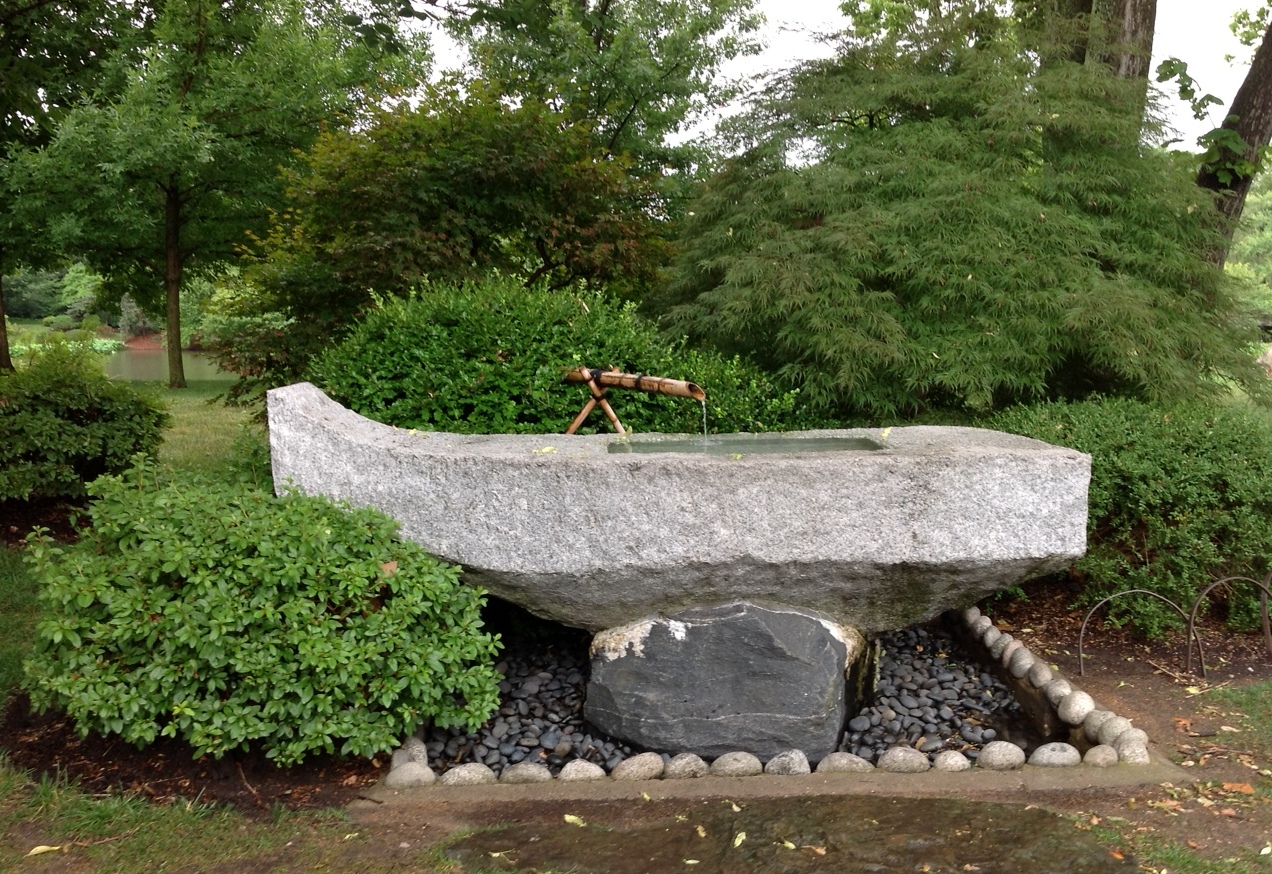
large basin at the entry of Seiwa-en

St. Louis World’s Fair of 1904

Seiwa-en was not the first public Japanese garden built in St. Louis. That distinction may belong to the three-plus acre Japanese garden at the Louisiana Purchase Exposition, more popularly known as the St. Louis World’s Fair of 1904, which opened a year late to allow for more participation by states and foreign countries. Like the World’s Columbia Exposition of 1893 in Chicago, also a year late, many of the structures were constructed to be temporary.

parts of this lantern date back to the 1904 St. Louis World’s Fair
(photo by Bill F. Eger)

The Fair opened on April 30 and, through the closing ceremonies on December 1, nearly 20 million visitors availed themselves of this opportunity to see the world, revel in “palaces” dedicated to progress and have some fun. And as was true with expositions or world fairs in Philadelphia and Chicago, more people were exposed to the Japanese aesthetic presented in these collections of historic garden styles.

1904 World’s Fair Japanese garden in St. Louis
(collection of the Missouri Historical Society)

To see what the 1904 Louisiana Purchase Exposition Japanese garden looked like from the air, take this visual ride in the Ferris Wheel: http://exhibits.slpl.org/lpe/data/lpe240022874.asp?thread=240029909

details, details

Photos not otherwise credited in this blog are by K.T. Cannon-Eger. Click on any image to see it full size.

outer gate to the tea garden

A personal note: Much gratitude is due professional photographer Scott Lokitz who picked us up near Union Station and drove us around all day. There’s something wonderful about being in the company of a person who loves their town. Scott was full of special spots and history, insight and genuine delight. There’s also something inspirational about being in the company of an accomplished professional. Scott showed us his studio, a beautifully restored brick building on Russell Boulevard at Mississippi. Anyone in the St. Louis area needing a high school senior portrait, event documentation, architectural photos, etc. should consider Scott Lokitz. http://scottlokitz.com/services.html

The Sister State relationship between Nagano and Missouri

A news article from Kansas City in the Lawrence Journal-World on April 27, 1964 announced the sister state relationship between Nagano Prefecture and the state of Missouri.

http://news.google.com/newspapers?nid=2199&dat=19640427&id=naZAAAAAIBAJ&sjid=_OUFAAAAIBAJ&pg=5648,2210584

A plaque outside the tea garden gate memorializes this Sister State relationship. The teahouse was dedicated on an auspicious date with a Shinto ceremony.

“The citizen of Nagano Prefecture, Japan, Sister State of Missouri, presents this teahouse to the citizen of Missouri as a memorial of the nice friendship between both states on the occasion of American Bicentennial year.”

Governor of Nagano Prefecture

Gonichiro Nishizawa

May 5, 1977

Addenda 27 August 2013

While scanning photos for a family tree at the behest of my sisters and brothers, I chanced upon a photograph from my grandfather’s trunk. His family lived in Frankfort, Kentucky. After graduating from Harvard University in 1905, he joined the U.S. Marine Corps and enjoyed a 30 year career with postings in China, Japan, Puerto Rico, Nicaragua, Washington DC and many other places.

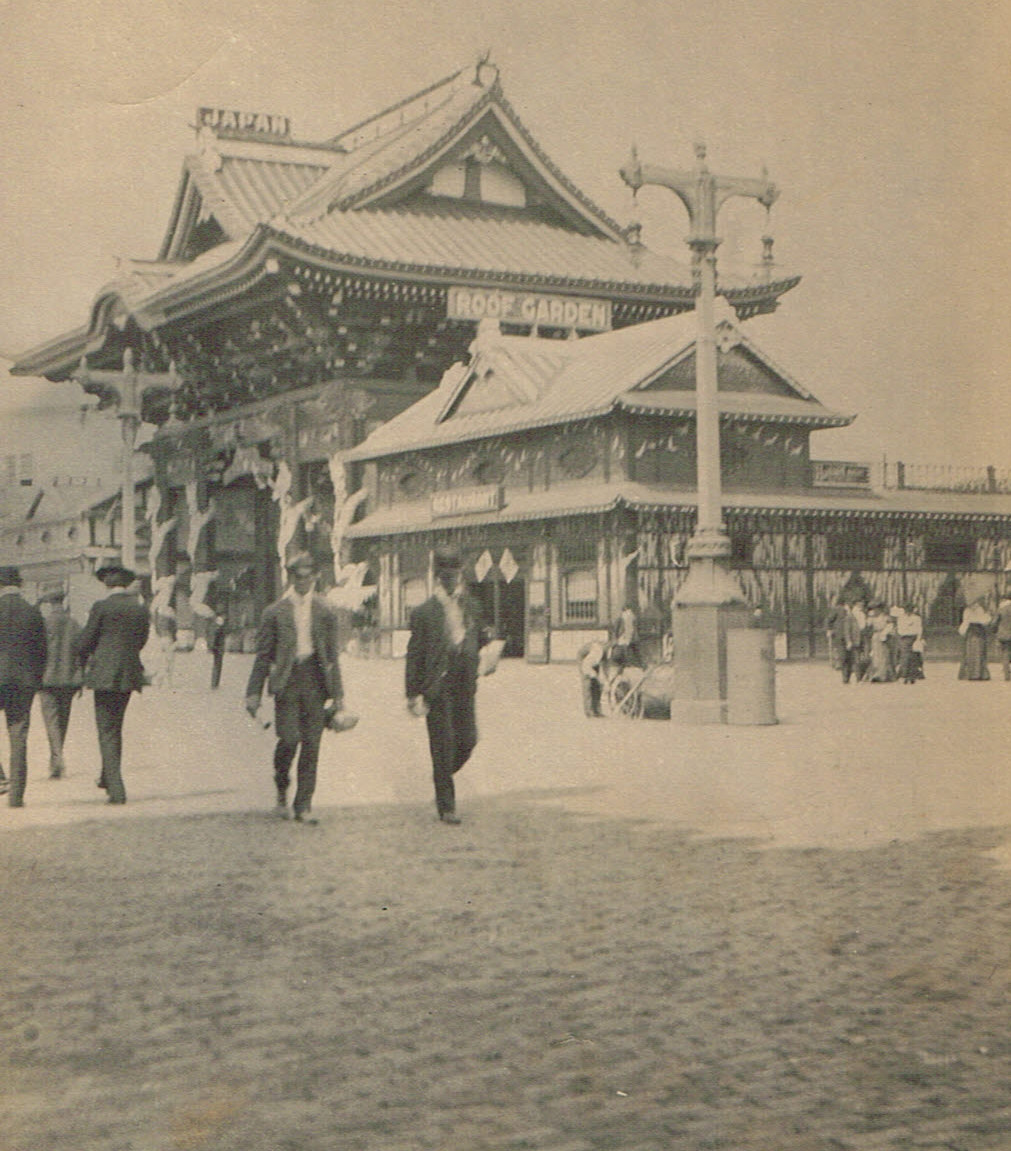
At first glance, I thought this image might be from one of those foreign locales, but with the aid of a magnifying glass I caught English words on the buildings. With confirmation from my friend Ken Brown, a world’s fair buff if there ever was one, I now add this photo of the Japanese exhibit at the Louisiana Purchase Exposition, popularly known as the St. Louis World’s Fair of 1904.

St. Louis 1904

Kendall H. Brown, professor of Asian art history at California State University Long Beach, identified my grandfather’s photo as “the ‘dragon gate’ at the Fair Japan exhibit at St. Louis. The Japan bazaar was on the left, the restaurant on the right.”
The restaurant bears the words “Roof Garden.” Photo courtesy of the Weitzel Family archives.

For additional views and information on the fair, visit

http://exhibits.slpl.org/lpe/data/LPE240024653.asp?thread=240029396

Categories: Missouri, St. Louis | Tags: , , , , , , , | 2 Comments

Conferences, symposia, workshops, tours, festivals and exhibits crowd the fall calendar

If you have been reading right along from Hilo to Atlanta to this point in the blog, you must be as seriously interested in Japanese gardens as we are. And if that’s true, you may wish to have one or more of these conference/symposium/workshop events on your schedule.

Edogawa Commemorative Gardens at Gosford
by Janda Gooding

The 7th International Symposium on Japanese Gardens: Japanese Gardens in the 21st Century will be held in Sydney, Australia, September 1 through 3. Early registration deadline already has passed. Among featured speakers are Mr. Iwatani, Mr. Yamada, Mr. Shiro Nakane, Ken Lamb, Kendall Brown, Mr. Kawase, Cap Saheki, and Mr. Mitsuhashi.

The symposium and hands-on workshops are hosted by Imperial Gardens Landscape and the International Association of Japanese Gardens. Also involved are the Edogawa Commemorative Gardens at Gosford and Auburn City Japanese Gardens. For more information and to register, contact: Imperial Gardens – Ken Lamb

18 Myoora Road, Terrey Hills NSW 2084

Telephone +612 9986 3968 Mobile +61 411 754 683

Email – enquiries@imperialgardens.com.au

Website – http://www.imperialgardens.com.au

The North American Japanese Garden Association will hold Connections 2012 in Denver October 12 through 14. The roster of speakers includes garden designer and author Marc Peter Keane, educator of Nishikigoi Mamoru Kodama, Writtle College, Essex, Reader in gardens and designed landscapes Jill Raggett, Portland Japanese Garden curator Sadafumi Uchiyama, Anderson Japanese Garden curator Tim Gruner, certified aesthetic pruner MaryAnn Burman, Chiba University professor of horticulture Eijiro Fujii, and garden artist and author David Slawson among others.

Hands-on workshops are planned at the Denver Botanic Gardens.

For further information or to register contact NAJGA at 503-222-1194 or send an e-mail

to info@najga.org or go to the organization’s web site: http://www.najga.org

summertime light at Anderson Japanese Gardens, Rockford, IL
(photo by K.T. Cannon-Eger)

The Maple Society will meet October 19 through 21 in Seattle with a post conference tour to Oregon October 22 through 24.

Speakers at the “Pacific Northwest Fantasyland Maple Adventure” include Matt Nichols, co-owner of Nichols Nursery, Flat Rock, NC; Charlie Morgan, owner Amazing Maples, Mukilteo, WA; David Degroot, author and Curator of Pacific Rim Bonsai Collection, Federal Way, WA; Don Brooks, Director Kubota Gardens, Seattle, WA; David Zuckerman, Head Horticulturist Washington Park Arboretum, Seattle, WA; and Talon Buchholz, owner of Buchholz & Buchholz Nursery, and plant introductions extraordinaire, Gaston, OR.

Gardens to be visited during the conference include Kubota Gardens, Washington Park Arboretum & Japanese Garden, Bellevue Botanic Garden, Rhododendron Species Foundation, Weyerhaeuser’s Pacific Rim Bonsai Collection, South Puget Sound Community College, Amazing Maples and Bloedel Reserve.

The three day post-conference tour includes Portland Japanese Garden, Hoyt Arboretum, Buchholz & Buchholz Nursery, Iseli Nursery, J. Frank Schmidt Nursery, Don Schmidt Nursery, Whitman Farms, Oregon Botanic Garden, and Munn’s Nursery.

Please register before September 15, 2012. Credit Cards Accepted. Marielle Eykeman PO Box 2635 Pt. Angeles, WA 98362 (360) 457-6952. More information is available at the web site: http://www.maplesociety.org/nab-seattle-2012

Other opportunities

Every botanic garden we visited, and many we haven’t yet seen, had some schedule of workshops, speakers or art exhibits.

For example, every Tuesday, Wednesday and Thursday at 10:30 a.m. the Atlanta Botanical Garden offers a strolling tour with a knowledgeable volunteer.

The Birmingham Botanical Garden has a Fall Plant Sale coming up October 20, 9 a.m. to 5 p.m. and October 21 noon to 4 p.m.

The New Orleans Botanical Garden holds plant sales on a regular basis. Two coming up soon are at Pelican Greenhouse, 9 a.m. to noon, Saturday, August 11, and Saturday, September 8. Check the City Park web site for more events. http://neworleanscitypark.com/

Fort Worth’s Japanese Garden will celebrate its annual Fall Festival 10 a.m. to 5 p.m. Sunday, October 27.

September 1 is opening day of the Dinosaur Stampede at San Antonio Botanical Garden.

Sunday, August 5, is family day at the Elizabeth Hubert Malott Japanese Garden in Chicago Botanic Garden starting at 11 a.m. hands-on activities related to Japanese arts and culture. Family Sunday repeats on September 2.

Denver Botanic Gardens has a number of activities around the general theme Kizuma: West meets East. Large site-specific bamboo art installations by Tetsunori Kawana and Stephen Talasnik continue through November 4. A lecture on Japanese gardens in the US will be given by curator Ebi Kondo Wednesday, September 12.  “Growing Autonomy – Gardening at Japanese American Internment Camps” is a talk by Dr. Bonnie Clark scheduled for Wednesday, October 10. Moonviewing or O-Tsukimi is slated for full moon in autumn Saturday, September 1.

Check the web sites of gardens near you for current events. There is a list of links to gardens we visited. Just click on Links at the top right side of the first page of this blog to get you started.

Categories: Colorado, Denver | Tags: , , , , , | Leave a comment

New Japanese garden surrounds Dallas high rise

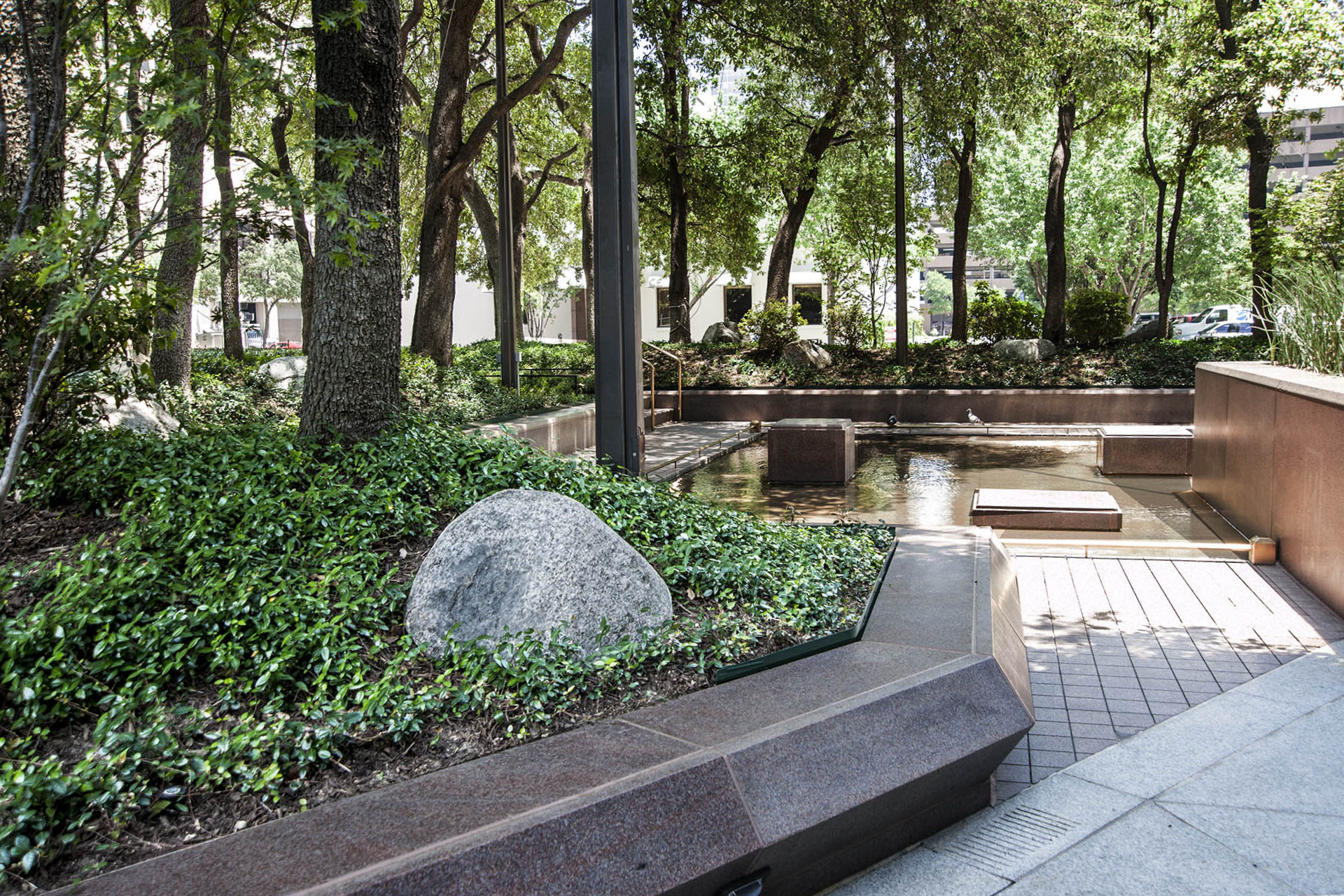
A modern take on the Japanese stroll garden is forming around the plaza level of the Trammell Crow Center in the art district of Dallas. Designed to expand the footprint of the Crow Collection of Asian Art, a free museum across the street from the Nasher Sculpture Center, this garden shows a different aspect around each side of the building. One side of the building features a stone arrangement, another a dry riverbed, another a shady grove or bamboo thicket, yet another a karesansui or flat landscape traditionally with raked gravel.

The plaza where we entered the garden.
(photo by Bill F. Eger)

“I have always considered the Crow Collection a museum without walls. In Asia, art and the environment coexist naturally. This garden will be a place for Dallas Arts District visitors to find art and Asia in unexpected places,” said Trammell Crow, president of the Crow Family Foundation. “I am grateful to our partners at Crescent (Real Estate Holdings) for giving us the perfect canvas for expansion.”

plaza view to the right of where we entered
(photo by Bill F. Eger)

The Dallas Arts District web site notes, “The Trammell Crow Center was deigned by Skidmore Owings & Merrill partner Richard Keating in 1984. Corporate offices are located on the upper levels of the building, and retail on the ground floor and mezzanine level.

dry riverbed makes the turn and continues toward the plaza
(photo by Bill F. Eger)

“In 1997, the Crow Family Foundation made the decision to share with the community one of the most important collections of Asian Art in the United States. A 12,000-square-foot space adjacent to the Trammell Crow Center was renovated, creating four light-filled galleries that evoke traditional aspects of Asian architecture in a museum without walls.”

bell tower awaits the installation of a bell
(photo by Bill F. Eger)

Planning for the new garden began by 2009, the year John Powell made a presentation on the design to the Women’s Council of the Dallas Arboretum and Botanical Garden spring meeting. Extensive installation work began in 2011. The new sculpture garden is slated to open later this year. When we visited in June, the sculpture had yet to be placed.

a base awaits sculpture from the Crow Collection of Asian Art
(photo by Bill F. Eger)

We parked beneath the office building — nearly empty on a Saturday morning — and took an elevator to the lobby level where security directed us to the garden and gallery beyond.

a suggestion of karesansui with a yotsume-gaki style bamboo fence and clipped shrubs

It was a Frisbee competition that first took garden designer John Powell to Japan in 1993 and he fell in love with the gardens. He launched an intensive study of Japanese garden design, construction and maintenance and in 1997, he attended the first Japanese garden seminar provided by the Japanese Garden Research Center at the Kyoto University of Art Design. This was followed by internships with Suzuki Zoen in Niigata, and at the Adachi Museum of Art in Shimane Prefecture. He was the first westerner to train as a gardener at Adachi.

Powell has become a respected part of the Adachi garden family and in 2006 spoke in Austin at the Taniguchi Garden Revitalization committee on Gardens of the Adachi Museum. This was part of a speaking tour with Wataru Takeda, Section Chief of the Business and Public Relations Department at the Adachi Museum of Art and, for the California presentations, Kiyoharu Mori, Deputy Director of the Adachi Museum of Art. The presentation also was given at The Modern Art Museum of Fort Worth, The Crow Collection of Asian Art, Houston Museum of Fine Arts, The Japanese Friendship Garden of San Diego at Balboa Park, The Asian Art Museum in San Francisco and Merritt College in Oakland.

hide and reveal — a passageway leads to a pond and a shady grove

grove of maples on the building side and a bamboo thicket on the street side

To learn more about The Adachi Museum of Art, visit their web site: http://adachi-museum.or.jp/e/index.html

a secluded pond
(photo by Bill F. Eger)

Powell is in demand as a workshop presenter and speaker for organizations such as the 6th International Symposium of Japanese Gardens in San Diego, the International Conference on Japanese Gardens Outside Japan in Long Beach and the Maple Society North America Branch.

Equisetum hymenale artfully disguises a utility area
(photo by Bill F. Eger)

Powell and his wife Becky are partners with David and Pat Bergman in Weatherford Gardens Nursery and Landscaping, an organic nursery and garden store located at 2106 Fort Worth Highway in Weatherford, Texas, featured in a previous blog entry.

details, details

The Trammell & Margaret Crow Collection of Asian Art is located in the Arts District of downtown Dallas.  The Crow Collection is a permanent set of galleries dedicated to the arts and cultures of China, Japan, India, and Southeast Asia.  The museum offers a serene setting for both quiet reflection and learning.

details, details

Admission is free. The Crow Collection of Asian Art is open Tuesdays – Thursdays (10 a.m. – 9 p.m.), Fridays – Sundays (10 a.m. – 6 p.m.), and closed on Mondays. For more information, please go to www.crowcollection.org or call 214-979-6430.

For further information or a look at aerial photographs of the office building, visit the web site: http://www.trammellcrowcenter.com/

stone arrangement near the bell tower

The Crow Collection’s European sculpture pieces formerly displayed in this area were re-located to the Old Parkland campus.

Unless otherwise credited, photos in this blog are by K.T. Cannon-Eger. Click on any image to see it full size.

UPDATE: While attending a North American Japanese Garden Association conference in March 2024, a return visit was paid to this area. The exquisite Crow Collection of Asian Art remains in the beautiful light filled building adjacent to the Trammell Crow Center. The landscape around the building and at the interior courtyard, however, was removed to make room for expansion of seating areas. We are leaving these photos and the article in place as a document of the work done to connect the exterior space to the interior art museum.

Categories: Dallas, Texas | Tags: , , , | 5 Comments

Plant and design resources in the Fort Worth area

For years as a subscriber to Journal of Japanese Gardening, John Powell’s name was familiar to me through his articles. The quality publication is now known as Sukiya Living.

In 2009, Powell was a speaker at the International Conference on Japanese Gardens Outside Japan sharing the stage with landscape architect Ron Herman and garden artist David Slawson. Their panel was titled “Bringing it all together: maintenance, growth & design.” His presence on the agenda was one of the reasons I chose to attend that formative conference in Long Beach.

John Powell and David Slawson talk shop at the 6th International Symposium of Japanese Gardens hosted by the Japanese Friendship Garden in San Diego in October of 2010. This conference is held once every two years, sponsored by The Garden Society of Japan and The International Association of Japanese Gardens Inc. The 2012 conference will be held in Australia.

We saw each other again in San Diego in 2010. Every time we had a chance to chat, he invited me to visit the next time I was in the Dallas-Fort Worth area.

Powell is a Japanese style garden builder and pruning specialist from Weatherford, Texas. He is a graduate of West Virginia University with a degree in Forestry. Currently he is the co-owner of Weatherford Gardens Nursery and Landscaping, located at 2106 Fort Worth Highway in Weatherford west of Fort Worth.

a sampling of products carried in the store
(photo by Bill F. Eger)

As noted on the nursery’s Facebook page: “In 1997, David & Pat Bergman, and John & Becky Powell purchased Mann Nursery. We re-named it Weatherford Gardens, and have been here ever since. We ditched all the chemicals and went organic in 1999, and it has been our real pleasure to sell only quality plants and organic materials to our gardening enthusiasts all over North Texas.”

a small section of the seed shelves where I did my shopping
(photo by Bill Eger)

Information sheets on soil types, deer resistant plants, drought tolerant plants, etc. line one bookshelf while new products such as woolen pockets for green walls are featured in the larger room.

“We do a lot of residential landscaping, and our landscape designer John Powell specializes in Japanese garden design. He has studied in Japan, and garden building is his passion.”

rock arrangement and plantings between the parking lot and the store

a sample waterfall to one side of the nursery
(photo by Bill F. Eger)

“Whether we install it or you do it yourself, our highly efficient and knowledgeable nursery and landscaping staff work to provide the best plants for your installations, and the highest professionalism and insight in any troubleshooting along the way,” the information page on Facebook concluded.

There was a nice sale going on the day we were there. Too bad these won’t fit in the backpack!
(photo by Bill F. Eger)

beautiful maple foliage and seeds
(photo by Bill F. Eger)

To learn more about Weatherford Gardens Nursery, visit them on Facebook http://en-gb.facebook.com/WeatherfordGardens?sk=info or at their store and nursery 2106 Fort Worth Highway, Weatherford TX 76086 or phone (817) 341-0152.

To learn more about the 7th International Symposium on Japanese Gardens: Japanese Gardens in the 21st Century to be held in Sydney Australia September 1-3, 2012, contact Imperial Gardens Landscape, PO Box 200 Terrey Hills, NSW 2084

web address: www.imperialgardens.com.au

and e-mail: enquiries@imperialgardens.com.au

All photos not otherwise credited in this blog are by K.T. Cannon-Eger. Click on any image to see it full size.

Categories: Fort Worth, Texas | Tags: , , | Leave a comment

Magnificent shapes and color at Metro Maples

Part of designing, installing and maintaining any garden is knowing where to go for quality plant material. This is particularly true of Japanese gardens.

At the beginning of our trip, we were thrilled to find Bill Hudgins’ Lush Life Home and Garden in the Buckhead area of Atlanta, Georgia. Hudgins is known for the 200-plus varieties of maples he’s collected.

At the mid-point of our journey in Fort Worth, I was quite literally jumping up and down and clapping my hands at the variety I saw when Bill and I drove in to Metro Maples on South Dick Price Road.

There are more than 15,000 maples from which to choose — more than 100 varieties of Japanese and Shantung maples including several patented varieties such as Acer truncatum ‘Fire Dragon’ — in sizes ranging from one-gallon pots up to 45-gallon pots.

Variety and abundance were the words of the day at Metro Maples in Fort Worth.
(photo by Bill F. Eger)

(photo by Bill F. Eger)

a weeping variety
(photo by Bill F. Eger)

Self-described “owner, grafter, salesman, yard man, hose dragger, web updater, bookkeeper” Keith Johansson has been seriously collecting maples, azaleas and rhododendrons in hot climates for 27 years. Jeri Bisel, his wife, and Scott Hubbel, the intern who came for two weeks in 2007 and stayed, round out the full-time crew at Metro Maples. All were on hand the day we visited.

I truly appreciate Keith’s attitude, perhaps best summed up with this remark: ” When walking through the garden, no king ever had it better.”

Scott Hubbel, Keith Johansson, and Jeri Bisel pose near sample plantings around a koi pond, the water from which is used for irrigation.

The company maintains an excellent, informative web site: http://www.metromaples.com/

Metro Maples does not ship. The nursery is open to the public from 8 a.m. until 2 p.m. on Saturdays. Monday through Friday, appointments must be made.

entry sign
(photo by
Bill F. Eger)

the driveway that set me dancing

Keith is the current president of the Maple Society, North America Branch. The fifth international maple symposium plus post-conference tours will be held in Seattle and Portland in October. The conference is October 19-21 and the tour October 22-24. For more information, go to the web site of the Maple Society: http://www.maplesociety.org/

All photos in this blog that are not credited to others are by K.T. Cannon-Eger. Click on any image to see it full size.

Categories: Atlanta, Fort Worth, Georgia, Texas | Tags: , , , | Leave a comment

Fort Worth garden should be seen every season

The Japanese Garden at the Fort Worth Botanic Garden is worth a return visit, in my opinion, every season of the year. Every season has its joys. The variety of plantings and styles of Japanese garden at Fort Worth offer that special kind of joy to all.

I visited two years ago in the spring, took 100 photos in an hour’s time, and have been mentioning it to my husband ever since. Our recent visit this summer, his first, entranced him as much as my first visit did me.

This seven and a half acre site was a watering hole for cattle, a gravel pit, a dump, and a squatters’ camp before Scott Fikes, former Botanic Garden director, and Charles Campbell, former director of Park and Recreation came up with and pursued the idea in the late 1960s. Kingsley Wu, a graduate of the University of Tokyo, was commissioned to finalize plans, according to a garden brochure, and construction began in 1970. After many clubs, companies and individuals put in their time, talent and treasure, the garden opened in 1973.

The resulting collection of gardens offers a pleasant stroll from the main gate through the free courtyard garden to the ticket office to the green and cool delights beyond.

The main gate was designed by Albert S. Komatsu and dedicated to Scott Fikes in 1976. The gift shop is off to the left.
(photo by Bill F. Eger)

A little history on the early designers

The main gate was designed by Albert Komatsu and Associates, an architectural firm founded in 1959 and later known as Komatsu Architecture. Alfred Komatsu was a well known, award-winning and highly respected architect in Fort Worth. He helped found the Society of American Military Engineers post in Fort Worth (SAME) and in 2011 was its oldest living founder.

The main gate was dedicated to Scott Fikes in 1976. Fikes retired in 1975 after serving 17 years as the Fort Worth Botanical Garden’s director. He served in the U.S. Army in World War II and was a member of the National Society of Landscape Architects. He passed away in 2002.

Charles Boyle Campbell was a landscape architect by training. He was 39 years old when he accepted the position in Fort Worth as director of parks in 1962. Two years later, the parks and recreation boards were merged and Campbell was named director of the new department.

“Throughout his quarter-century of service, he was a strong advocate for the creation of green space, and during his tenure, city regulations were amended to require residential developers to set aside parkland in their subdivisions. During the years he served as director, the number of parks increased from 57 parks on 2,872 acres to 163 parks with 9,923 acres,” said Susan Allen Kline in the book Images of America: Fort Worth Parks. Campbell retired in 1987 and passed away in 2006.

Steve Huddleston remarked on Kingsley Wu on the occasion of the 75th anniversary of the Fort Worth Botanic Garden: “The major project in the garden during the late ‘60s and early ‘70s was the construction of the Japanese Garden, a 7.5-acre garden that is now the crown jewel of the Fort Worth Botanic Garden. In 1968, the city employed Kingsley Wu, professor of environmental living at Texas Women’s University, to design a master plan for the Japanese Garden.  The three major pools were staked and then 454 cubic yards of concrete were poured to line the pools. A waterfall, spillways, and islands were fashioned in and around the pools.  Patterned after the Ryoan-ji in Kyoto, the meditation garden was built in 1970.”

a school group enjoys the classic karesansui
(photo by Bill F. Eger)

Among new plantings this spring are cherry trees, the gift of the Japanese Embassy to mark the centennial of Tokyo’s gift to the United States of more than 3,000 cherry trees planted at the Tidal Basin in Washington, D.C.

“The most reliable and readily available variety of flowering cherry is the ‘Kwanzan’ (Prunus serrulata ‘Kwanzan’),” says Scott Brooks, senior gardener at FWBG. He oversees the 7 ½ acre Japanese Garden there. “It’s capable of reaching 25 feet in height with branches that start out upright and then spread horizontally. It has 2-inch-wide, rose-pink flower clusters. Newly planted trees produce a good showing of flowers, although bloom improves as the trees mature.”

Another variety that does well here, Brooks says, is Yoshino (Prunus x yedoensis), the variety Japan gave to the United States in 1912. It’s a fast-growing tree that can reach more than 30 feet. Although the young trees do not produce a lot of flowers, mature trees bloom profusely.

Springtime crabapple bloom with new maple leaves near the pavilion in 2010

Brooks came to the garden in 1982 as a groundskeeper. By then many of the original trees had matured. The garden was clotted with vines and undergrowth. Tunnels had formed where the original designers had created paths.

Brooks set about the hard work of carefully uncovering what Fikes, Campbell, Komatsu and Wu had created, traveling several times to Japan. There gardeners steeped in 1,500 years of tradition taught him: “If you’re the keeper of a Japanese garden, you need to think about removing something every year,” he said.

dry stream
(photo by Bill F. Eger)

Brooks now is the senior gardener. He showed us through, with that ever watchful gardener’s eye for something amiss or out of place, and spoke of the delights and challenges of this ever changing scene.

Sister City

Nagaoka and Fort Worth have an active and dynamic Sister City relationship, celebrating 25 years this year in October. Mayor Betsy Price and Councilman Danny Scarth will lead a delegation to Nagaoka, Japan, to join in their fall festival October 2 to 12.

In the 1990s, Nagaoka, donated an authentic Mikoshi (a gilded and lacquered palanquin) to Fort Worth, which is currently on display within the Mikoshi House. Several trees, including pines and flowering cherries, were similarly donated.

Mikoshi — a gift of Sister City Nagaoka

view out the door of Mikoshi House

Mikoshi House in the spring of 2010

In 1997, Mr. Shigeichi Suzuki, a landscape architect from Nagaoka, donated plans for a karesansui-style addition to the garden.

“When I received the plans, they were in kanji and metric,” said Brooks chuckling. “That was a wonderful challenge figuring that out.”

The addition was completed in 2000, and is now called the Suzuki Garden. It is a modern counterpart to the nearby classic karesansui of the same design as the abbot’s quarters of Ryoanji in Kyoto.

Suzuki Garden
(photo by Bill F. Eger)

The tea house at the end of the pond was built as a memorial to the late Mary K. Umstead, secretary to the Horticulture Division. It was rebuilt this past year using plantation-grown ipe as a more lasting, sustainable tropical hardwood.

Mary K. Umstead Tea House, rebuilt in the past year

A new barrier free approach to the pavilion area offers visitors a closer view of the main waterfall. The Shinto-esque pavilion area offers several structures available for rental for special celebrations and weddings.

new waterfall view
(photo by Bill F. Eger)

Behind the pavilion area, a small staircase leads to a plaza. Out of view to the right is barrier free access to the same area.
(photo by Bill F. Eger)

moon-viewing platform and amphitheatre
(photo by Bill F. Eger)

“The ‘Moon-Viewing Deck’ is a creative adaptation of the Ginkakuji temple’s famous ‘Kogetsudai’ sand cone. Fort Worth’s version is intended to be an interactive karesansui exhibit, in which visitors may ascend the flat-topped cone via steps, and view the composition from above. A ‘Taijitu’ (a yin-yang symbol), lies embossed in exposed-aggregate concrete at the summit. This highly unusual (but fun) addition to a Japanese garden is ultimately a cosmological symbol of Chinese origin. It also has other interpretations, including its most important contemporary association with Korean culture, and as a metaphor for oriental mysticism in American ‘Pop’ culture. The exhibit also features an amphitheatre that is countersunk into the same platform as the cone. Together, they serve as a performance venue for the garden’s two annual festivals (matsuri), and as a moonlit chapel for weddings,” Brooks said

Paths

In all, there are nearly 6,000 linear feet of stone, brick, wood, aggregate concrete and asphalt walkways in the garden, three pools and a couple of waterfalls including a small one in the corner of the entry to the gift shop, seven crossings over water, multiple fish food dispensers, an abundance of healthy koi in the ponds and plants to occupy the eye and mind.

gift shop in the spring of 2010

gift shop in the summer 2012 — note the impact of recent drought on the pond water level
(photo by Bill F. Eger)

Treasure Tree gift shop occupies a waterside structure reminiscent of medieval Japanese architecture. The well stocked store is operated by the Fort Worth Botanical Society. Proceeds benefit the continuing development and preservation of the garden.

The garden is included in the Fort Worth Botanic Garden web site http://fwbg.org/gardens/japanese/ and maintains its own Facebook page http://www.facebook.com/pages/Fort-Worth-Japanese-Garden/168365139854742 on which Brooks has included several detailed guides to the plantings in multiple scrapbooks.

Operating hours during standard time are 9 a.m. to 5 p.m. daily and during daylight saving time 9 a.m. to 7 p.m. daily except Christmas. Admission fee for adults is $4.50 on weekends or $4 on weekdays; $3 for children ages 4 to 12. Children ages 3 and under are admitted free. Unsponsored children under 13 are not admitted. One adult may sponsor 5 children.

For additional information, call (817) 871-7686.

enticing benches
(photo by Bill F. Eger)

Photos with no credit line in this blog are by K.T. Cannon-Eger. Click on any image to see it full size.

Several videos of the Fort Worth Japanese Garden are featured on YouTube. Here is a short one from the spring festival http://www.youtube.com/watch?v=Xqj2KIb-DQs

and a longer piece featuring spring blooms

http://www.youtube.com/watch?v=4FWsA2UCqUY

another featuring a summertime stroll with emphasis on the koi http://www.youtube.com/watch?v=j_ysysau35U

a taiko performance of Ujigawa by Dondoko Daiko at the 2009 fall festival http://www.youtube.com/watch?v=upJ-5udVI4s

and one longer narration from winter http://www.youtube.com/watch?v=0dZCKCbo378

A personal note:

There’s something really wonderful about garden friends: you speak the same language, share similar goals, and in the best of times have the same taste in movies and jokes. Scott Brooks is one of those wonderful garden friends.

We met briefly in Long Beach, California, in spring of 2009 at the International Conference on Japanese Gardens Outside Japan. A year later, I stopped off in the Dallas-Fort Worth area on my way home from my mother’s death in Florida. My cousin dropped me off at the garden gate and I began my wandering in a somber mood.

Pretty soon, I was engaged by the collection of gardens – entranced by proportions, variety and trimming of various plantings.

Scott Brooks at work in 2010

As I wandered down the right side of the garden, I noticed maintenance going on at the left side of the pond. I kept catching glimpses of this man in a black t-shirt pushing a wheelbarrow. When I finally came even with him, I asked the perennial gardener’s question, “What are you working on?” “Re-doing the water pipe to this basin,” he replied “Have you been here long?” I asked. “28 years since 1982.” “Say, you look familiar….” and when we got to Long Beach as common ground he exclaimed, “You’re that lady from Hawaii.”

forsythia near the pag

Later, as I approached the end of the path to meet up with my cousin at the gift shop, there was a splash of yellow by the pagoda – forsythia, one of my mother’s springtime favorites.

The Long Beach conference not only formed fast friendships, it led to the formation of the North American Japanese Garden Association (NAJGA). Fort Worth hosted one of the regional meetings that led the group from initiative to association.

The organization hosts a web site http://www.najga.org/cfm/index.cfm and a Facebook page. NAJGA will host Connections 2012, a conference for garden professionals and enthusiasts in Denver, Colorado, October 12 through 14 with a one-day advance design workshop on October 11. The conference is geared toward three topics every garden deals with: horticulture, human culture and business culture. Contact NAJGA for further information and to register.

pagoda designed by Albert Komatsu
(photo by Bill F. Eger)

Categories: Fort Worth, Texas | Tags: , , , , , , , , , , , , | 2 Comments

Blog at WordPress.com.